
Hurricane Charley in 2004 and Irma in 2017 are still part of local memory, but Ian and Milton are the storms most Winter Haven homeowners mean when they talk about trees coming down. Both crossed the peninsula with Polk County in their path. Their damage looked different, and the differences matter for how you care for trees now.
Hurricane Ian Tree Damage in Polk County (2022)
According to the National Hurricane Center's report, Ian made landfall on Cayo Costa on September 28, 2022, with estimated maximum sustained winds of 130 knots, about 150 mph, then came ashore again near Punta Gorda and weakened steadily as it moved northeast across the state overnight. By the time it reached Polk it was a much weaker storm, crossing the county as a Category 1 hurricane, according to The Ledger.
Ian's bigger story in Polk was water. The NHC noted that counties north of Ian's track, Polk among them, saw significant flooding when the Peace River and other rivers crested at record levels. The Ledger reported preliminary rain totals of nearly 17 inches in Lake Wales, with smaller amounts elsewhere in the county, and a fastest Polk wind of 78 mph per the National Weather Service.
What Ian did in Winter Haven
- About five Winter Haven streets were closed by downed trees and power lines the day after the storm.
- The city had five water main breaks, mostly from wind-toppled trees whose roots broke pipes as they lifted.
- Winter Haven Regional Airport reported significant hangar damage.
- Around 137,000 Polk residents, more than 30 percent of the county, were still without power at midday two days after landfall.
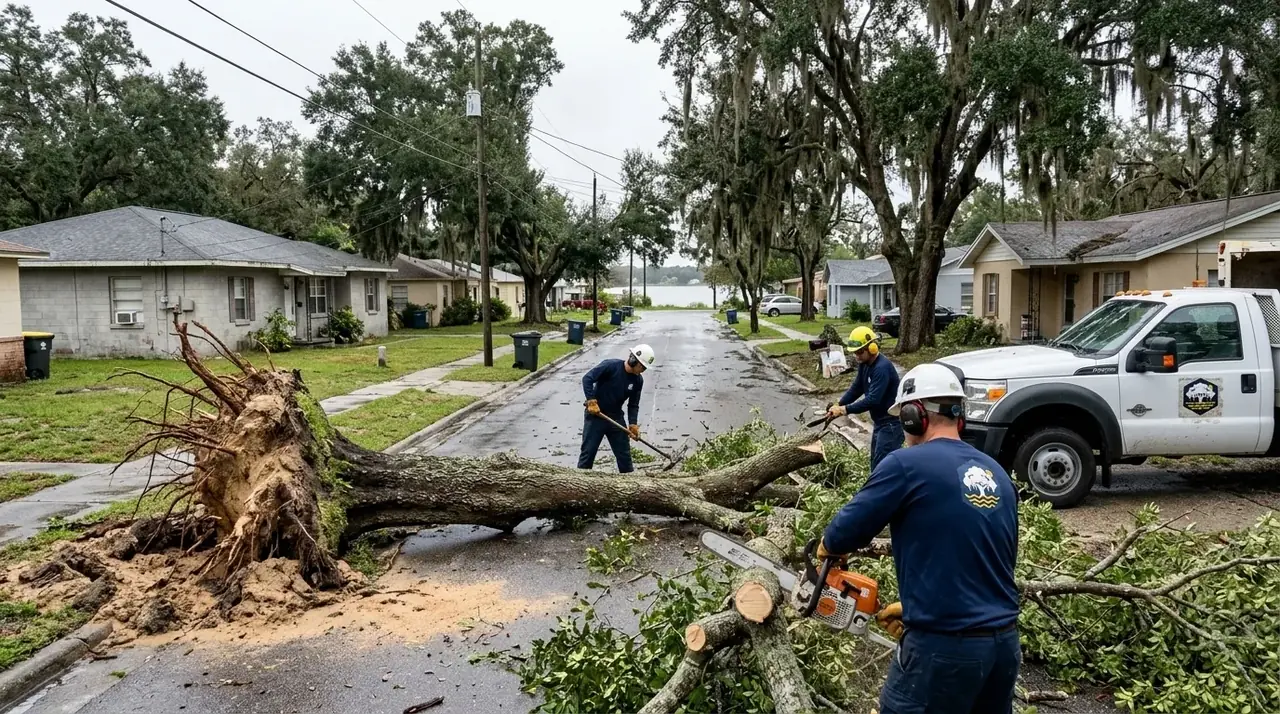
Those details come from The Ledger's September 30, 2022 report. The pattern behind them is familiar: saturated sandy soil lost its grip on root plates, and whole trees tipped rather than snapping. Uprooting tends to happen when a slow storm drops a lot of rain before the strongest wind arrives.
Hurricane Milton Tree Damage in Winter Haven (2024)
Milton made landfall on Siesta Key on the evening of October 9, 2024. The NHC's post-storm report estimates maximum sustained winds near 100 knots, about 115 mph, at landfall. The center then moved east-northeast across the peninsula on a path that carried it across Polk County, and it reached the Atlantic near Cape Canaveral early on October 10.
Winter Haven felt Milton's wind directly. The National Weather Service Tampa Bay post-storm report lists the ASOS station at Winter Haven Regional Airport among its ten highest land winds, with sustained wind of 49 knots and a gust of 76 knots, roughly 56 mph sustained and 87 mph gusting. The NHC notes that station's wind record was incomplete, so the true peak may have been higher.
The cleanup was enormous. Polk County reported in February 2025 that its contracted haulers had collected 24,415 loads of Milton debris totaling 911,341 cubic yards, with about 95 percent of roads cleared. Much of that volume was tree limbs, trunks and palm fronds.
| Storm detail | Ian (2022) vs. Milton (2024) |
|---|---|
| Florida landfall | Ian: Cayo Costa, Sept. 28, about 150 mph / Milton: Siesta Key, Oct. 9, about 115 mph |
| Main local threat | Ian: prolonged rain and river flooding / Milton: stronger gusts plus heavy rain |
| Typical tree failure | Ian: uprooting in saturated soil / Milton: uprooting plus broken limbs and trunks |
| Polk measurement worth noting | Ian: 78 mph fastest Polk wind / Milton: 76-knot gust at Winter Haven Regional Airport |
Which Polk County Trees Failed in Hurricanes
UF/IFAS researchers studied urban trees after ten hurricanes, including Charley, and ranked species by wind resistance. Their Southeastern Coastal Plain list fits Winter Haven's common yard trees well:
- Highest wind resistance: live oak, sand live oak, southern magnolia, crape myrtle, podocarpus, bald cypress, pond cypress and sabal palm.
- Medium-low: red maple, camphor, slash pine, longleaf pine and loblolly pine.
- Lowest: laurel oak, water oak, pecan, Chinese tallow, southern red cedar and sand pine.
The researchers also point out that laurel oak typically lives around 50 years and begins to decay and show disease as it nears 40. A lot of Winter Haven neighborhoods were planted with laurel oaks decades ago, which is why so many of the trees we cut after Ian and Milton were big laurels with hidden decay at the base.
Pines can fail months later
UF/IFAS found that pines may look fine right after a storm and then decline. Three months after Charley, they measured 27 percent of standing south Florida slash pines and 48 percent of standing longleaf pines as dead. Pines can die over six months to two years after a windstorm. If a pine near your house browns out the spring after a hurricane, have it looked at quickly.
Palms usually come back
As a group, palms survived better than broadleaf trees and conifers in the UF/IFAS work, and sabal palm is a standout. The researchers advise allowing at least six months for a damaged palm to push new fronds before writing it off. Our palm tree trimming crews leave the healthy green fronds in place rather than stripping a palm bare, which weakens it.
Storm Lessons for Winter Haven Homeowners
The same research offers practical lessons that apply directly to Polk County streets:
- Trees in groups did better than lone trees. In the study, a group meant five or more trees each within 10 feet of another.
- Trees with more rooting space survived more often, and street trees with cramped root zones fared worst.
- Cutting major roots weakens anchorage. UF/IFAS advises never cutting roots closer to the trunk than five times the trunk diameter.
- Older trees with decay, cavities or large dead limbs are the most likely to fail.
Storm Damage Cleanup Around Winter Haven
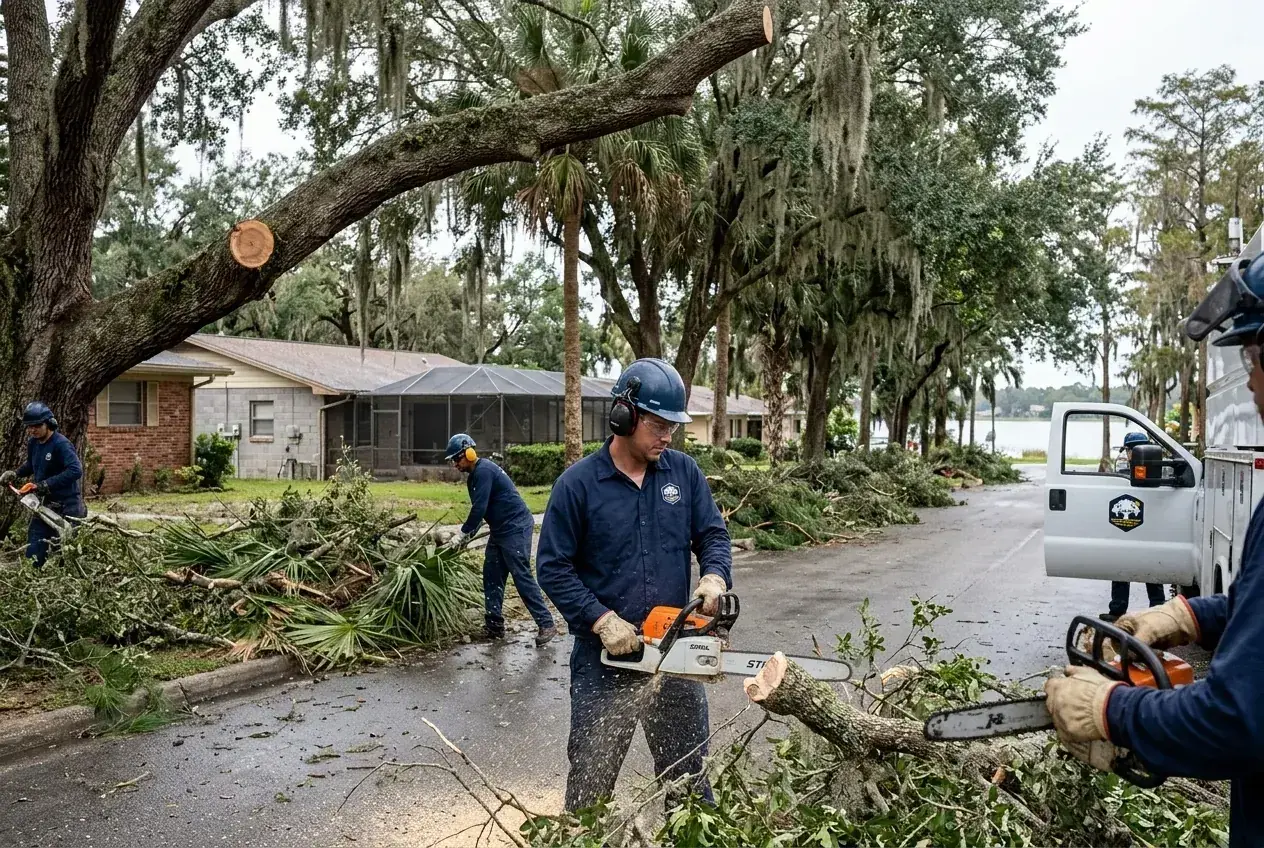
When a tree does come down, safety comes first. Stay clear of any tree touching a power line and report it to your utility. Duke Energy Florida or Tampa Electric serves most Winter Haven-area addresses, depending on where you live. Do not try to cut a trunk that is under tension, because spring-loaded wood can kick with enough force to break bones.
Our emergency tree removal line runs 24/7 for trees on houses, cars and driveways. For yard-wide messes after the danger has passed, storm damage cleanup covers hanging limbs, split trunks and debris haul-off. We photograph the damage before cutting so your insurance adjuster can see what happened. Neighborhoods with tall pines and old oaks, like those around Inwood and Florence Villa, tend to call first after a storm, so getting on a list early helps.
Checking Winter Haven Trees After a Hurricane
Not every storm-damaged tree has to come down. Once the roads are open and the power is back, walk your yard in daylight and look for the warning signs that separate a cosmetic mess from a real hazard:
- Soil heaved up or cracked on one side of the trunk, a sign the root plate has shifted.
- A new lean that was not there before the storm.
- Split or cracked trunks, especially where two large stems meet in a tight V.
- Broken limbs still hanging in the canopy, often called hangers, that can drop days or weeks later.
- Bark peeled away in long strips, which can mean the wood underneath twisted and cracked.
Leaf loss on its own is not a death sentence. UF/IFAS notes that trees stripped of some or all of their leaves in a hurricane are not necessarily dead, and that in their north Florida observations live oak shed leaves and small branches readily yet stood up well to high winds. Their advice is to wait and watch for new growth. If a tree has not leafed out again by the spring or early summer after the storm, it is time for a closer look.
Documenting storm damage for insurance
Take wide photos that show the whole tree and what it hit, then close-ups of the break or the root plate, before anything is moved. Keep receipts for emergency work like tarping or removing a tree from a roof. Policies differ a great deal on what they cover for trees, so read yours or call your agent early. When we arrive for a storm call, we take our own photo record too, and we are glad to share it with your adjuster.
Lakefront homes deserve an extra look before storm season, because wet banks let trees tip more easily. Our guide to trees and shorelines on the Chain of Lakes covers that side of storm prep.