Winter Haven calls itself the Chain of Lakes City, and with good reason. The city counts 50 lakes within or bordering its limits, with 8 lakes in the North Chain and 14 in the South Chain, plus other public lakes that are not connected for boating. The city also notes that Winter Haven sits at the top of the Peace River watershed, so what happens on these shorelines travels a long way downstream. For a tree crew, that means lakefront work is a little more careful than a front-yard removal.
Lakefront Tree Service on the Winter Haven Chain of Lakes
Lakefront trees face a mix of conditions you don't see a few blocks inland. Roots sit in saturated soil for long stretches, banks shift when water levels move, and the open fetch across a big lake lets wind build before it hits the first row of trees. Lake Eloise alone covers roughly 1,174 acres on the south chain, which is plenty of open water for a summer squall to gather speed.
We see three recurring problems on lakefront lots: trees leaning out over the water as they reach for light, roots undercutting a seawall or a bank, and limbs hanging over docks and boat lifts. Each one has a fix, and not every fix is removal. Our lakefront tree service starts with a walk along the shoreline to sort out which trees are holding the bank and which are threatening it.
Bald Cypress Trees Along Winter Haven Shorelines
Bald cypress is the classic shoreline tree here. It is a native deciduous conifer that tolerates standing water and drops its needles in winter, then leafs out again in spring. Those knobby knees around the base are part of the root system. Removing them for a cleaner look can stress the tree and loosen the soil around it.
Cypress also earns its place in storms. In the UF/IFAS study of urban trees after ten hurricanes, bald cypress and pond cypress were placed in the highest wind-resistance group for the Southeastern Coastal Plain list. That does not make any single tree storm-proof, but a healthy cypress at the water's edge is usually one to keep.
| Common shoreline tree | What we usually recommend |
|---|---|
| Bald cypress | Keep and prune lightly; protect the knees and root zone |
| Live oak near the bank | Keep; reduce long limbs over docks and water |
| Laurel oak or water oak leaning over water | Inspect for decay; often a removal candidate as it ages |
| Chinese tallow | Remove; prohibited in Florida and invasive near water |
| Camphor | Remove or plan for removal; invasive and not recommended by UF/IFAS |
Shoreline Erosion and Tree Roots on Winter Haven Lakes
The city's own code makes the case for shoreline plants. Section 21-291 of the Unified Land Development Code explains that shoreline vegetation stores sediment and nutrients, and that wave action and runoff cause erosion where vegetation has been removed. Eroded soil slowly fills the lake and feeds algae. In other words, the plants along your bank are doing real work.
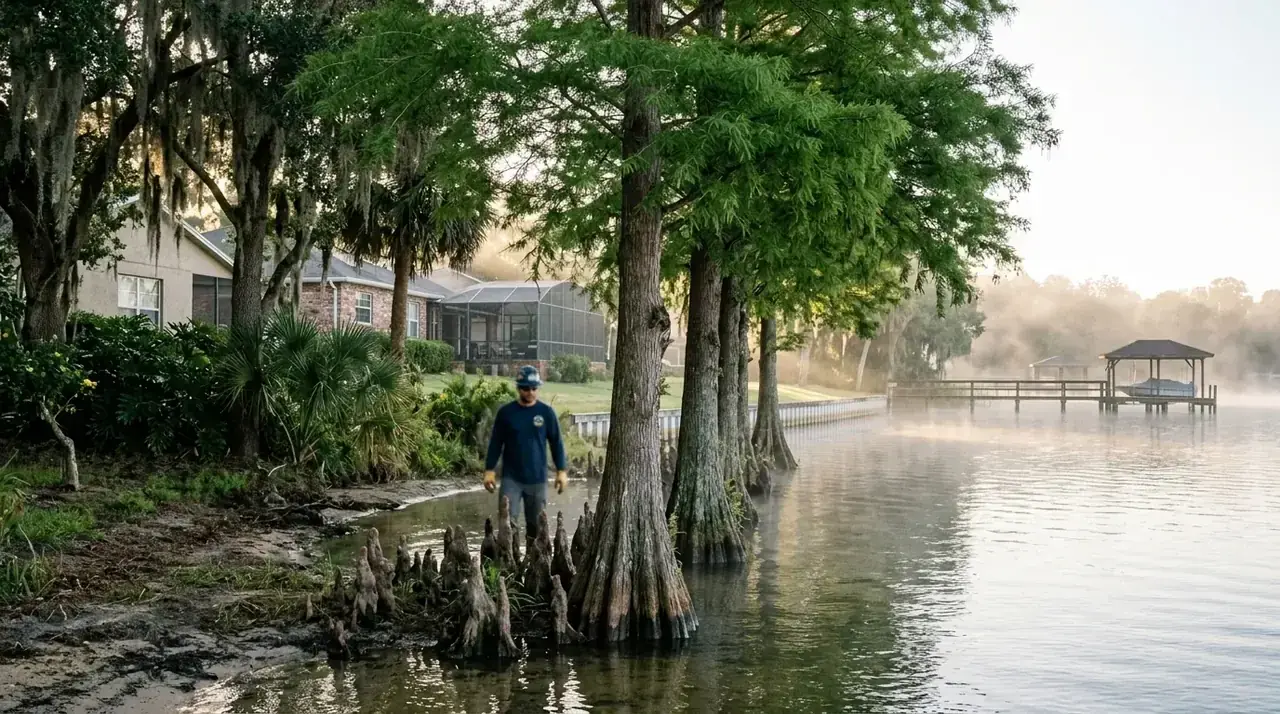
Tree roots are part of that picture. A mature tree with a spreading root plate can hold a bank together for decades. When that tree dies and the roots rot, the bank can slump in a year or two. That is why we prefer to leave a cut stump in place on a fragile bank instead of grinding it out, and why we suggest replanting with native shoreline species after a removal. We talk through that choice on every stump grinding quote near the water.
Docks, Seawalls and Lakefront Tree Trimming in Winter Haven
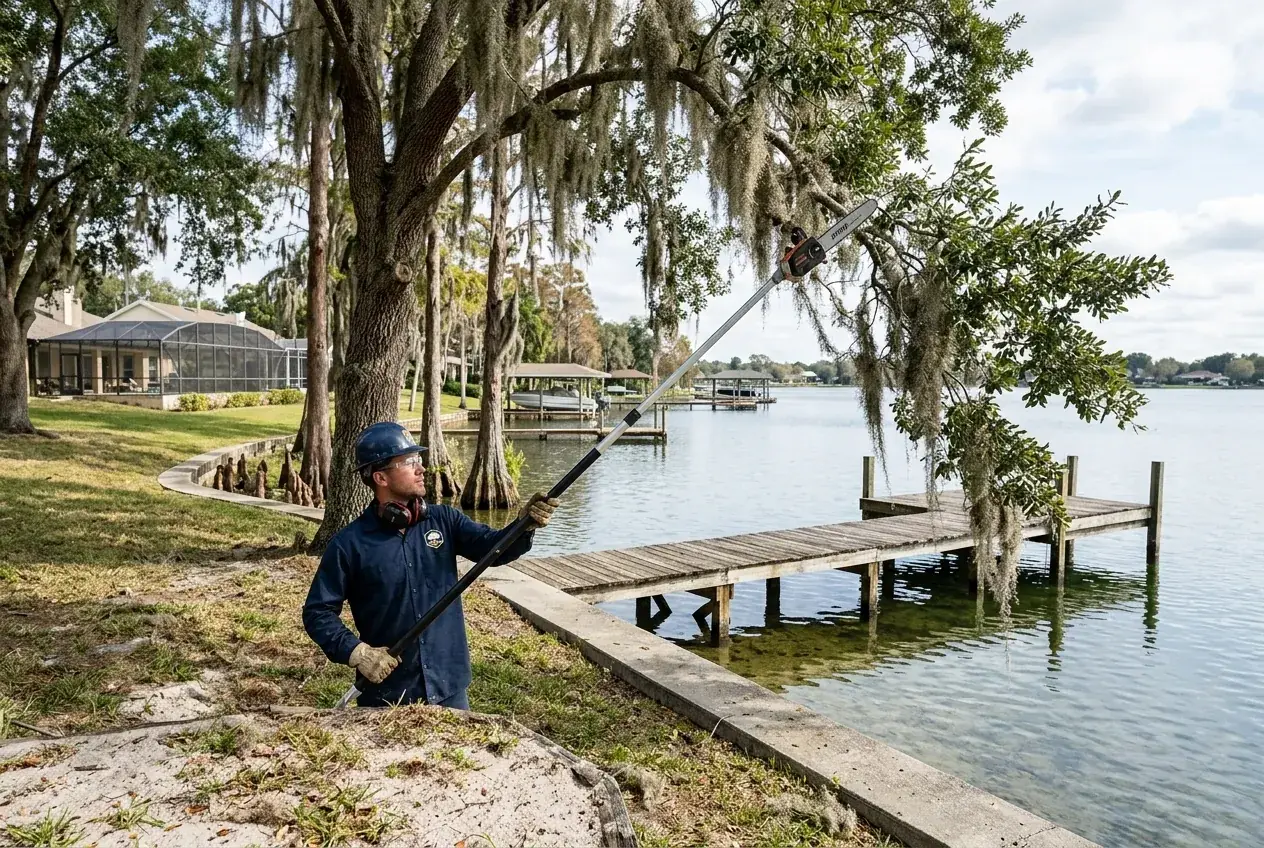
Docks and seawalls change how we work. We set up from land whenever possible and coordinate dock or seawall access ahead of time when a tree leans over the water. Limbs are roped down so nothing lands on decking, boat lifts or canopies. Pieces that fall short go into the lake, and we retrieve them rather than leaving debris to drift.
Seawalls have their own risk. Roots can push against a wall from behind, and a large tree rocking in the wind can loosen the soil that backs it. If a tree right behind a seawall is healthy, we often reduce the canopy so it catches less wind rather than removing it. If the wall is already cracked, talk to a marine contractor before any heavy equipment comes near it.
Winter Haven Shoreline Rules for Trees and Vegetation
Several layers of rules can touch a lakefront tree job. This is a summary, not legal advice, and we confirm the details with the city, county or state on every estimate.
City of Winter Haven Lakeshore Protection
Inside the city, Article V, Division 3 (Sections 21-291 to 21-296) restricts shoreline clearing. Under Section 21-293, an owner clearing less than 50 feet or 50 percent of owned shoreline, whichever is less, does not need a permit. Clearing more requires all state and federal permits first. Section 21-292 exempts ordinary lawn mowing and trimming that does not clear aquatic vegetation, and maintenance of an already-cleared shoreline that has been kept clear. Once vegetation is allowed to grow back, a permit is needed to clear it again. Violations can bring restoration orders and fines.
FWC aquatic plant rules
Florida Statute 369.20(8) lets a riparian owner on fresh water physically or mechanically remove herbaceous aquatic plants and semi-woody plants, such as shrubs and willow, within a corridor of up to 50 percent of the frontage or 50 feet, whichever is less, to reach open water. That exemption excludes herbicides, does not apply in Aquatic Preserves or Outstanding Florida Waters, and does not cover activities that need a state wetland permit. The Florida Fish and Wildlife Conservation Commission administers aquatic plant permits and can tell you what your lake allows.
State wetland permits
Work that dredges, fills or otherwise alters wetlands and surface waters can require an Environmental Resource Permit under Part IV of Chapter 373, Florida Statutes. In this part of Polk County that typically runs through the Southwest Florida Water Management District or the Florida Department of Environmental Protection. Cutting a tree that stands in the water, or hauling equipment across a marsh fringe, is the kind of job where we check first.
Unincorporated lakefront lots
Lakefront homes outside city limits, including many in Cypress Gardens and around Eloise, follow Polk County's code rather than the city's lakeshore division. The state rules above still apply. Our post on tree removal permits in Winter Haven explains the city and county split in more depth.
Invasive Trees on the Winter Haven Chain of Lakes
Chinese tallow is the invasive tree we pull most often near water. Its seeds spread easily, and UF/IFAS lists it as prohibited in Florida. Camphor is another common one in older neighborhoods, flagged by UF/IFAS as invasive and not recommended. The city's tree division exempts removal of species on the Florida Invasive Species Council list, so on non-exempt properties these are the easiest trees to justify taking out.
Removing an invasive does not end the job. Tallow resprouts from stumps and roots, so a cut stump may need follow-up treatment, and near water any herbicide work has its own permitting rules. We plan that step with you instead of walking away from a stump that will be a thicket next summer.
Storms and Lakefront Trees in Winter Haven
High water and wind arrive together in a hurricane. After Ian in 2022, the boat ramp at Lake Shipp Park was nearly underwater and part of Lake Howard Drive stayed closed while floodwaters receded, according to The Ledger's coverage. Saturated banks let trees tip more easily. If you live on the North Chain of Lakes or the south chain, have shoreline trees checked before peak season, and read our look at how Ian and Milton hit Polk County trees for the species that held up best.