Service area · Winter Haven
North Chain of Lakes Tree Service for Winter Haven Lakefront Homes
Big cypress at the waterline, oaks leaning over canals, and palms on every seawall. We handle tree removal, trimming and storm cleanup for homes on the north end of the Winter Haven Chain of Lakes, working from land and coordinating dock access when it helps.
North Chain of Lakes Tree Service From Lake Hartridge to Lake Fannie
The northern Winter Haven Chain of Lakes is a separate group of ten lakes from the better-known southern chain: Lake Haines, Lake Rochelle, Lake Echo, Lake Conine, Lake Fannie, Lake Smart, Lake Henry, Lake Hamilton, Middle Lake Hamilton and Little Lake Hamilton. They are linked by their own canals and run north and east from the city toward the next towns. State Road 544, called Lucerne Park Road here, is the spine of the area, running along the east side of Lake Conine and the northwest cove of Lake Smart before it heads toward Lake Fannie.
Lake Hartridge, on the north side of Winter Haven, technically belongs to the south chain, but a canal off its northeast side reaches Lake Conine, so we treat it as the gateway to this stretch. Our crews work the residential shorelines here most weeks, from older block homes with deep backyards to newer houses on cleared lots.
Lakefront Tree Removal in Winter Haven's North Chain: Shorelines and Soils
These lakes are wilder than the downtown lakes. Lake Fannie's shoreline is largely wooded and swampy, Lake Smart is bordered by homes on the north and west with woods and citrus groves around much of the rest, and Lake Conine has residential edges to the north and southwest with woods on the other sides. That mix means you get bald cypress and pond cypress at the waterline, laurel and water oaks on the slope, slash pine on the higher sand, and a lot of volunteer growth where nobody has cleared in years.
The soil changes fast over a short distance. Up by the house it is loose ridge sand that drains in minutes, and by the seawall it is saturated muck that stays soft after every rain. Trees rooted in that wet zone can look healthy and still have a weak grip, which is why shoreline oaks are often the first to tip in a hurricane. It also means heavy equipment cannot drive down to the water on many lots, so we plan to rig wood uphill or float it out by arrangement.
Invasive Chinese tallow and camphor show up along many of these banks. Both are listed by the Florida Invasive Species Council, so removing them is usually encouraged rather than restricted, and clearing them out lets the native cypress and oaks breathe.
Lakes and roads we cover on the north chain
- Lake Smart — about 277 acres off SR-544, with oaks over backyard docks and old grove rows that have gone wild behind some lots.
- Lake Conine — roughly 237 acres along Lucerne Park Road, mostly ringed by the city but outside its limits, with laurel oaks and pines on the residential shores.
- Lake Fannie — the big one at around 800 acres, reached off CR-544, where cypress and swamp hardwoods crowd the shore and canal mouths.
- Lake Hartridge — a figure-eight lake near Beach Parkway and Lake Hartridge Nature Park, with older homes on the west side and the canal toward Conine.
- Lake Haines — connected by canal to Lake Rochelle on the north end of the chain, with mature oaks over waterfront yards.
- The canals between lakes — overhanging limbs and fallen trunks that block boat traffic after storms, cleared from the bank wherever possible.
Tree Trimming on the North Chain of Lakes: Common Jobs
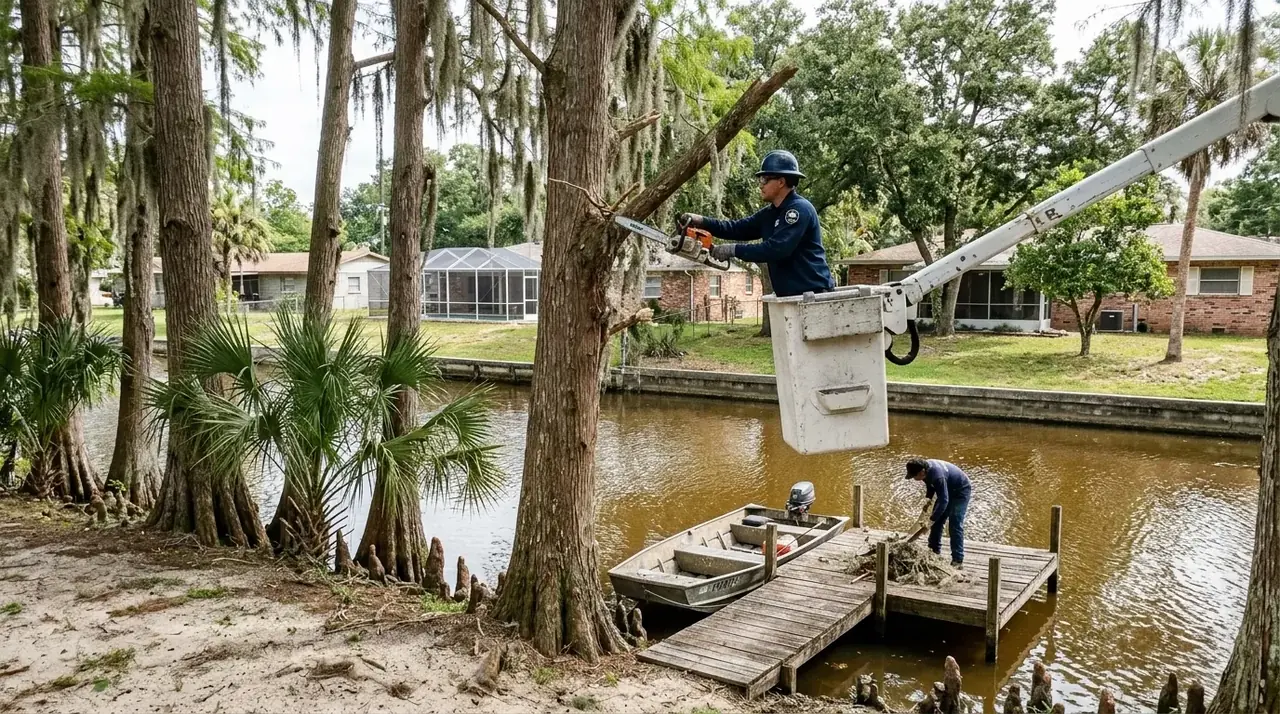
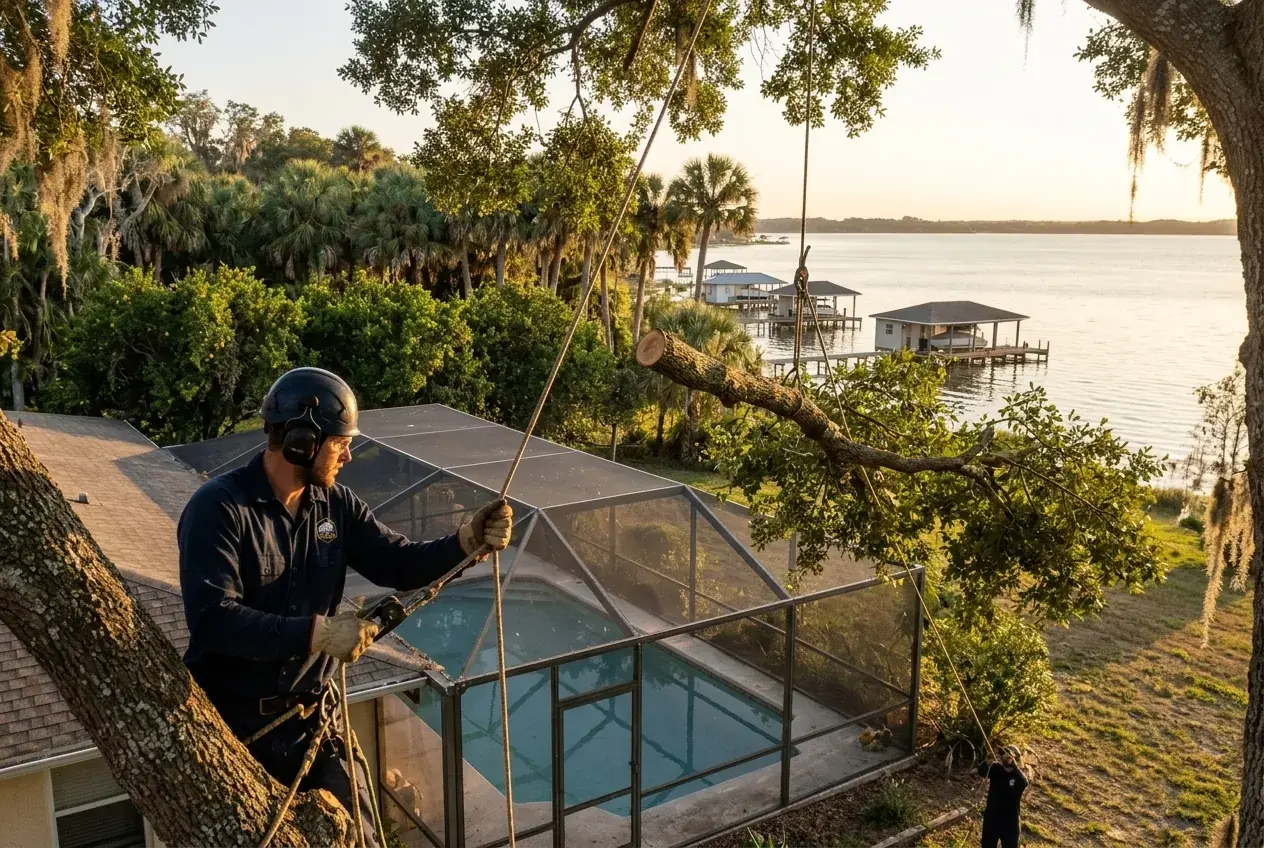
The calls we get from this area are a little different from in-town work. Owners want limbs lifted so they can see the water from the porch, dead cypress tops removed before they fall on a boathouse, oaks pulled back from pool cages, and palms cleaned up along the seawall. After storms, the work shifts to clearing trees off docks and out of canal mouths. Hurricane Ian in 2022 and Hurricane Milton in 2024 both left this side of Polk County with flooded yards and uprooted shoreline oaks, and saturated ground kept trees tipping for days after the wind dropped.
We work from land first. When a tree hangs over the water and there is no way to rope it uphill, we coordinate dock or barge access with you and, where it applies, with neighbors whose shoreline we need to cross.
North Chain of Lakes Tree Rules: City, County and Shoreline
Jurisdiction here depends on the lake and even the lot. Much of the area is inside the City of Winter Haven, where Chapter 21 of the Unified Land Development Code governs tree protection and, as we read it, generally exempts single-family and duplex lots from tree permits. Lake Conine itself sits outside the city limits, so some of its shoreline falls under unincorporated Polk County, and the north end of the chain reaches into neighboring city limits. Because the line can split a single street, we check the parcel and confirm the rules with the city or county on every estimate.
Cutting trees on dry land is one thing. Removing plants below the normal high-water line, or disturbing the shoreline itself, can fall under state rules from the Florida Fish and Wildlife Conservation Commission or the Department of Environmental Protection, so we keep stumps and roots in the bank intact unless the right approval is in hand. On a single-family home, Florida Statute 163.045 lets you remove a tree that an ISA Certified Arborist or licensed landscape architect has documented as an unacceptable risk without a local permit, and we can arrange that report when a lakefront tree is clearly failing.
Tree Removal Cost on the North Chain of Lakes
Lakefront access is the biggest price factor here. A removal that would be routine in a dry backyard can cost 10 to 30 percent more when wood has to be carried up a long slope, lowered over a seawall or moved by boat. A medium laurel oak in the $850 to $1,800 range can climb past that on a steep bank, and a mature cypress over 60 feet usually starts around $1,800 and runs to $3,600 or more, with a crane adding $600 to $1,800 when one can reach. Thinning a canopy for a water view is often a better value at $175 to $900 per tree, and palm cleanups along the seawall typically run $85 to $285 per palm. We price every job in writing on site, and the walk-through for hazard trees is free.
Lakefront Tree Services We Offer on the North Chain
Our lakefront tree service is built around exactly this kind of property, and it often pairs with view-focused tree trimming and pruning. When a shoreline oak has to go, our tree removal crew plans the drop around docks and seawalls, and storm damage cleanup covers the trunks and limbs that land in canals after a hurricane. For overgrown back lots and old grove rows, light land clearing opens up space without stripping the bank. Our post on trees and shorelines on the Winter Haven Chain of Lakes goes deeper into what to keep along the water.
Tree Service Near the North Chain of Lakes: Nearby Areas
Just south of Lake Hartridge, the Florence Villa neighborhood runs along First Street and Lucerne Park Road. Downtown and the Lake Silver area are a few minutes farther, and the canal-linked South Chain of Lakes picks up on the other side of the city. To the southwest, Inwood rounds out the north side of town.
Questions
North Chain of Lakes Tree Service FAQ
The northern chain has ten lakes: Lake Haines, Lake Rochelle, Lake Echo, Lake Conine, Lake Fannie, Lake Smart, Lake Henry, Lake Hamilton, Middle Lake Hamilton and Little Lake Hamilton. They are connected by their own canal system, separate from the southern chain. Lake Hartridge is counted with the south chain, but its northeast canal reaches Lake Conine.
Often, yes. We climb the tree and use ropes and a lowering device to swing each piece back over land before it drops. When the lean is too far out or the bank is too soft, we coordinate dock access or a small barge so the wood never lands in the water. The access plan is set during the free estimate.
Lake Conine itself sits outside the city limits even though Winter Haven nearly surrounds it, so parts of its shoreline are unincorporated Polk County while nearby lots are in the city. That affects which tree rules apply. We look up the parcel before quoting and confirm the requirements with the right office for that address.
Trees on dry upland are handled like any other yard tree under city or county rules. Work below the normal high-water line, or removal of aquatic and wetland plants, can fall under state rules from the FWC or DEP. We leave cypress stumps and roots in the bank to hold the soil and confirm what is allowed before touching anything at the waterline.
Plan on roughly 10 to 30 percent above a comparable dry-lot removal when wood has to be carried up a slope, lowered over a seawall or moved by water. A medium oak that would be $850 to $1,800 inland may land above that range. A crane, when it can reach, adds about $600 to $1,800 and sometimes saves time and lawn damage.
We clear trunks and limbs from canal banks and the shallow edges we can reach safely from land or a dock. Larger blockages in open water may need coordination with the agency that manages the canal. We photograph storm damage before cutting so you have a record for insurance and for any neighbors whose shoreline is involved.
The ground near the water is often saturated muck while the soil uphill is loose sand. Roots in that wet zone stay shallow and lose grip when the lake rises after heavy rain. Add hurricane wind across open water and a healthy-looking oak can tip at the root plate. Crown reduction lowers the sail area and helps a lot.
Usually, yes. Raising the lower canopy and thinning a few interior limbs opens sight lines without topping the tree, which would weaken it. Most view pruning runs $175 to $900 per tree. We mark the limbs with you before cutting, so you see exactly which branches are coming out and nothing is removed that you wanted to keep.
Nearby
Winter Haven Areas Close to North Chain of Lakes
Tree work in North Chain of Lakes? Start here
One visit, one written number, and a crew that cleans up after itself. North Chain of Lakes is close to home for us.
Mon–Sat 7:00am–7:00pm (24/7 emergency line for storm work) · Licensed & insured