
Winter Haven · Polk County, FL
Tree Risk Assessment for Winter Haven Properties
A free hazard walk-through comes with every estimate, covering decay, lean, root plates and what a tree could hit. When you need it in writing, we arrange a formal report from an ISA Certified Arborist.
Tree Risk Assessment in Winter Haven, Explained Plainly
Most people call us about one tree, but the question behind the call is usually bigger: is this thing going to fall on my house? A risk assessment answers that in an organized way. It looks at how likely a tree or limb is to fail, how likely it is to hit something if it does, and how bad that would be. A dead pine over an empty field is low risk. A hollow laurel oak leaning over a bedroom is not.
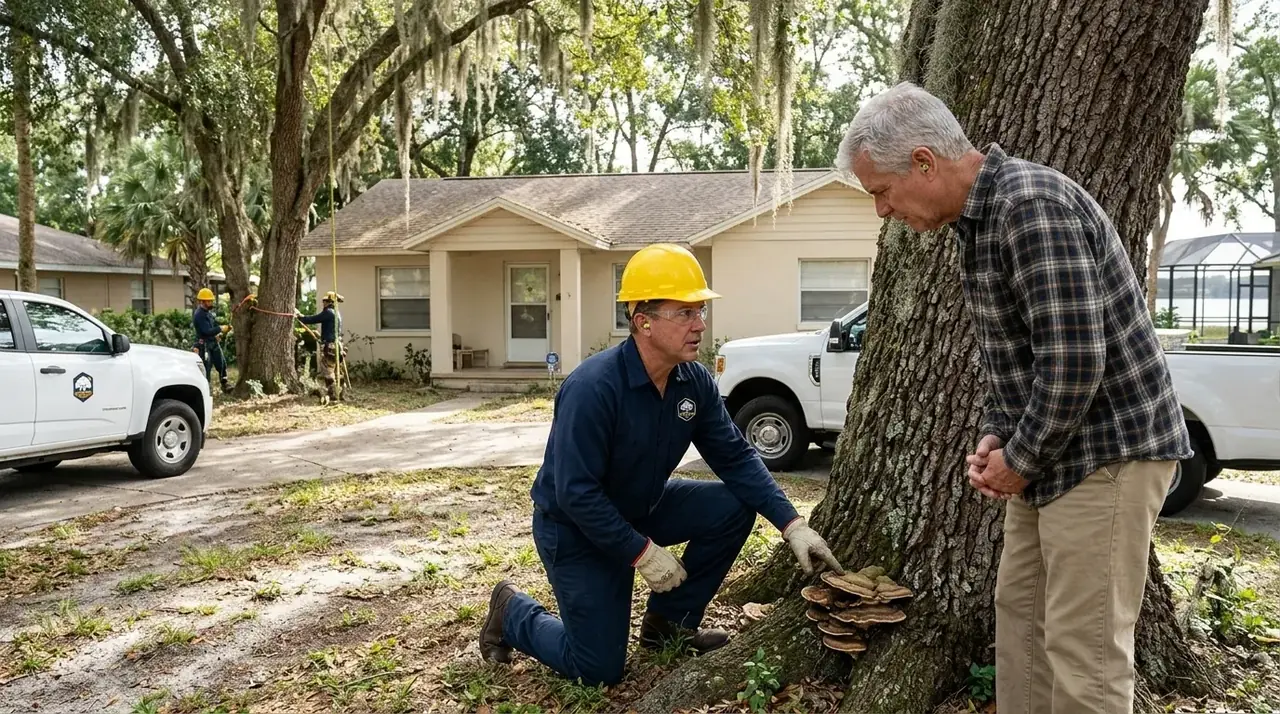
We offer two levels of help. The first is a free hazard walk-through with any estimate, where our crew lead looks at the trees you are worried about and points out what they see. The second, when you need it on paper, is a formal written assessment. We do not claim to be certified arborists; for written documentation we arrange an assessment from an ISA Certified Arborist and pass the cost through without markup.
What the Free Hazard Walk-Through Covers
- Decay signs at the base and trunk: mushrooms, conks, cavities, soft or hollow-sounding wood
- Cracks, splits and weak forks with included bark
- Lean, and whether it is old and stable or new and getting worse
- Root plate condition: lifted soil, cut roots, saturated or eroding banks
- Dead limbs, hangers and broken tops in the canopy
- Targets under the tree: the house, driveway, pool cage, play set, street or neighbor's roof
Tree Risk Assessment Methods: How the ISA System Works
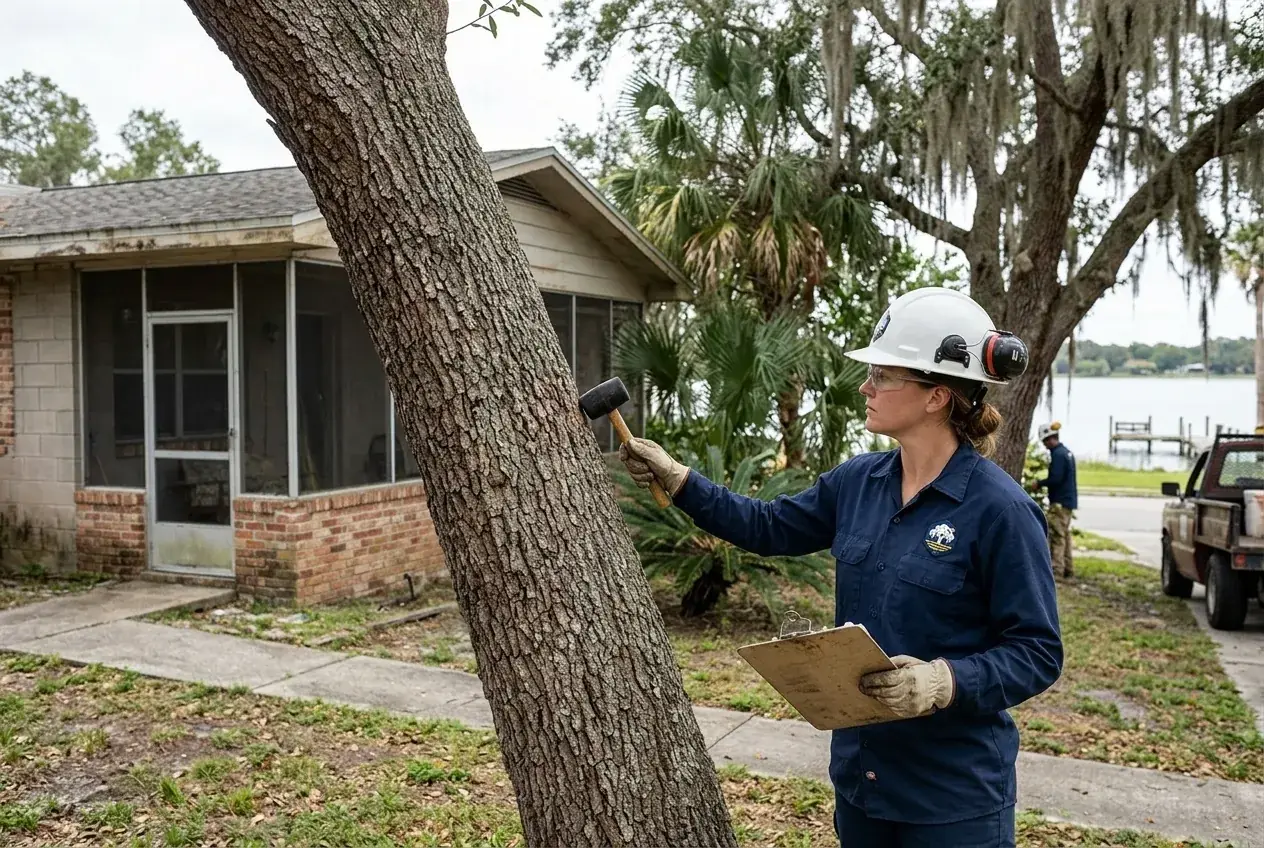
The International Society of Arboriculture publishes Best Management Practices for Tree Risk Assessment, now in its second edition from 2017. It describes three levels of assessment. A limited visual assessment is a quick look, often from the ground, to spot obvious problems across many trees. A basic assessment is a detailed ground-level inspection of individual trees, often with simple tools like a mallet and probe. An advanced assessment adds specialized work such as aerial inspection or decay-testing tools when a basic look cannot answer the question.
The BMP rates three things. Likelihood of failure runs from improbable to possible, probable and imminent. Likelihood of impact runs from very low to low, medium and high. Consequences run from negligible to minor, significant and severe. Combined, those give an overall risk rating of low, moderate, high or extreme, along with options to reduce it, such as pruning, cabling, moving the target, or removal.
In practice, most homeowner questions are answered at the basic level. Advanced work is usually saved for big, valuable trees where the answer changes what happens next, such as a large live oak over a house that might be saved with cabling or might need to come down.
What a Written Report Usually Contains
- Property address, date, the assessor's name and ISA credential, and their signature
- Tree location, species, size and a description of its condition
- The level of assessment and any tools used
- Defects found and the targets within reach of the tree
- Likelihood of failure, likelihood of impact, consequences and overall risk rating
- Mitigation options and the residual risk after each one
Tree Risk Assessment Cost in Winter Haven, FL
The walk-through is free with any estimate, and most homeowners never need more than that. A written report costs extra because a credentialed arborist has to inspect and sign it, and we arrange it at cost when you need it. The table shows typical totals for related work, so you can see how assessment fits with the fix.
| Job | Typical range | What moves the price |
|---|---|---|
| Hazard walk-through with an estimate | Free | Included with any quote |
| Written ISA arborist report | At cost, quoted up front | Number of trees, level of assessment |
| Risk-reduction pruning after assessment | $175 – $900 per tree | Tree size, limbs over targets |
| Cabling or bracing a flagged fork | $350 – $1,200 per tree | Number of cables or rods |
| Removal of a tree rated high risk | $325 – $3,600+ | Height, access, crane need |
Tree Risk Documentation and Florida Statute 163.045
Florida Statute 163.045, passed in 2019 and amended in 2022, limits what a local government can require for trees on residential property. If the owner has documentation from an ISA Certified Arborist or a Florida licensed landscape architect that a tree poses an unacceptable risk to persons or property, the city or county cannot require a notice, application, permit, fee or mitigation to prune, trim or remove it, and cannot require replanting. Since 2022, documentation means an on-site assessment done under the 2017 ISA tree risk BMP and signed by the assessor, and a tree counts as unacceptable risk when removal is the only practical way to bring its risk below moderate.
That law matters in Winter Haven because city and county tree rules can otherwise require permits for some removals. If you are thinking about a statute-based removal, we arrange the assessment, help you keep the paperwork on hand, and schedule the work. Our blog post on tree permits in Winter Haven and Polk County covers the city and county side.
Using a Risk Assessment for Insurance or an HOA
Insurers sometimes ask homeowners to address overhanging trees, and HOAs and condo boards often want something in writing before approving a removal. A documented assessment gives them a clear, standard reason. It can also help settle disagreements with a neighbor about a tree on the property line, since it describes the condition of the tree without opinion.
Real estate deals are another use. A buyer's inspector may flag a large tree near the house, and a written assessment gives both sides something specific to negotiate around instead of guesses.
Tree Hazard Checks for Common Winter Haven Trees
Certain trees around here deserve a closer look. Mature laurel and water oaks often decay from the inside. Pines that took lightning can die from the top down. Trees on lake banks along the Chain of Lakes can lose root anchorage when water stays high after big storms like Ian and Milton. Palms with Ganoderma conks at the base are a known removal case. And any tree whose roots were cut for a driveway, pool or new septic line should be watched for a few years. Our post on tree roots and septic systems covers that last one.
Neighbor trees count too. If a tree on the next lot leans over your roof, we can look at it from your side and tell you what we see, though any work on it needs the owner's permission.
When a Formal Report Is Not Needed
If a tree is obviously dead, already failing or clearly healthy, and nobody needs paperwork, a formal report is extra cost for no benefit. Most pruning and many removals on private lots can be handled with our free walk-through and the normal permit check. We will tell you when a written report actually helps and when it does not.
Records help long after the visit. Keep any written assessment with your house papers, and note the date of any work done because of it. If a tree rated moderate today is checked again in a few years, the older report shows whether things are getting better or worse.
Timeline
The free walk-through happens during the estimate visit, usually within a few days of your call. A written ISA arborist assessment typically takes one to two weeks to schedule and deliver. If a tree looks dangerous during the walk-through, we do not wait for the report to make it safe.
Tree Risk Assessment Near Downtown, Florence Villa and the Lakes
We do hazard walk-throughs across Winter Haven, including older shade trees downtown and near Lake Silver, big oaks in Florence Villa, shoreline lots on the north Chain of Lakes and yards in Inwood. To schedule yours, request a free estimate and list the trees that worry you.
Questions
Winter Haven Tree Risk Assessment: Common Questions
Yes. Our crew lead does a hazard walk-through of the trees you are concerned about as part of any free estimate. We look at decay, cracks, lean, roots and what each tree could hit, and we explain what we see. There is no charge and no obligation. A formal written report from an ISA Certified Arborist is the only part that costs extra.
We do not claim that credential. For written assessments that need it, including documentation under Florida Statute 163.045, we arrange an assessment from an ISA Certified Arborist and pass the cost through at cost. The walk-through you get with an estimate is our crew's practical opinion based on what we see, not a certified report.
It stops a local government from requiring a notice, application, permit, fee or mitigation for pruning, trimming or removing a tree on residential property when the owner has documentation from an ISA Certified Arborist or Florida licensed landscape architect that the tree poses an unacceptable risk. It also bars requiring replanting. The documentation must follow the 2017 ISA tree risk assessment BMP.
Under the 2022 amendment, a tree poses an unacceptable risk if removal is the only practical way to bring its risk below moderate, using the tree risk assessment procedures in the 2017 ISA Best Management Practices. A tree that could be made acceptable by pruning or cabling does not meet that test. The assessor makes that determination on site and signs the documentation.
The statute defines residential property as a single-family, detached building on a lot actively used for single-family residential purposes, as a conforming or legally recognized nonconforming use. A single-family rental house can qualify. Duplexes, apartment complexes and commercial sites generally follow the usual city or county tree rules instead. We help you check how your property is classified before any work is scheduled.
The ISA method rates three factors: likelihood of failure, from improbable to imminent; likelihood of impact, from very low to high; and consequences, from negligible to severe. Combining them gives an overall rating of low, moderate, high or extreme. The report also lists ways to reduce risk and the risk left over after each option.
It can. Some insurers ask homeowners to deal with trees over the roof, and a written assessment shows what was evaluated and what was recommended. After a loss, records showing you had trees checked and acted on the advice can be useful. Insurers set their own rules, so ask your agent what they want to see.
Most HOAs want a reason in writing and sometimes photos. A written arborist assessment showing high risk is usually enough for a board to approve a removal. Some associations have their own forms or replanting rules. Send us the HOA's requirements and we will help you put the right paperwork together before the work is scheduled.
For most yards, a look every few years is plenty, plus a check after any named storm. Trees near the house, over a pool cage or on a lake bank deserve more frequent attention, as do older laurel oaks and any tree with cabling. If you notice a new crack, lean, mushrooms at the base or dead limbs, call sooner.
Yes. Laurel and water oaks often rot from the inside while the canopy stays green, and root decay can hide underground. That is why an assessment looks at the base, the trunk and the soil, not just the leaves. Sounding the trunk with a mallet, probing cavities and looking for fungal growth all help reveal problems a full canopy can hide.
Related
Other Winter Haven Tree Services
Not sure if it is safe?
Ask for a hazard walk-through with your free estimate and get a straight answer.
Mon–Sat 7:00am–7:00pm (24/7 emergency line for storm work) · Licensed & insured