
Winter Haven · Polk County, FL
Palm Tree Trimming in Winter Haven, FL
Dead fronds, seed stalks and fruit cleared from sabal, queen, Washingtonia and date palms, without stripping them into feather dusters. Most palms run $85 to $285 each.
Palm Tree Trimming Winter Haven Palms Actually Need
Palms are the most over-trimmed plants in Florida. Plenty of yards around the lakes have sabals cut down to a tight tuft of fronds pointing straight up, which looks tidy for a month and quietly starves the palm. A palm pulls nutrients out of its older fronds before they turn brown, so cutting green and yellowing fronds early takes away food the palm was still using. Our approach is simple: remove what is dead, seed stalks and fruit clusters if you want them gone, and leave the green canopy alone.
UF/IFAS guidance puts the hard limit at the 9 o'clock and 3 o'clock line, imagining the crown as a clock face, and says even that is a ceiling rather than a goal. We stay well above it. The so-called hurricane cut, where most of the fronds are stripped off before storm season, is not backed by research, and a palm with a full head of fronds generally weathers wind better than a stripped one.
Smaller ornamental palms are part of most jobs too. Pygmy date, foxtail and Christmas palms mostly need old fronds and seed clusters removed once a year, and they are quick to do while the crew is already set up.
What Palm Trimming Includes
- Removing fully brown, dead fronds cleanly at the base
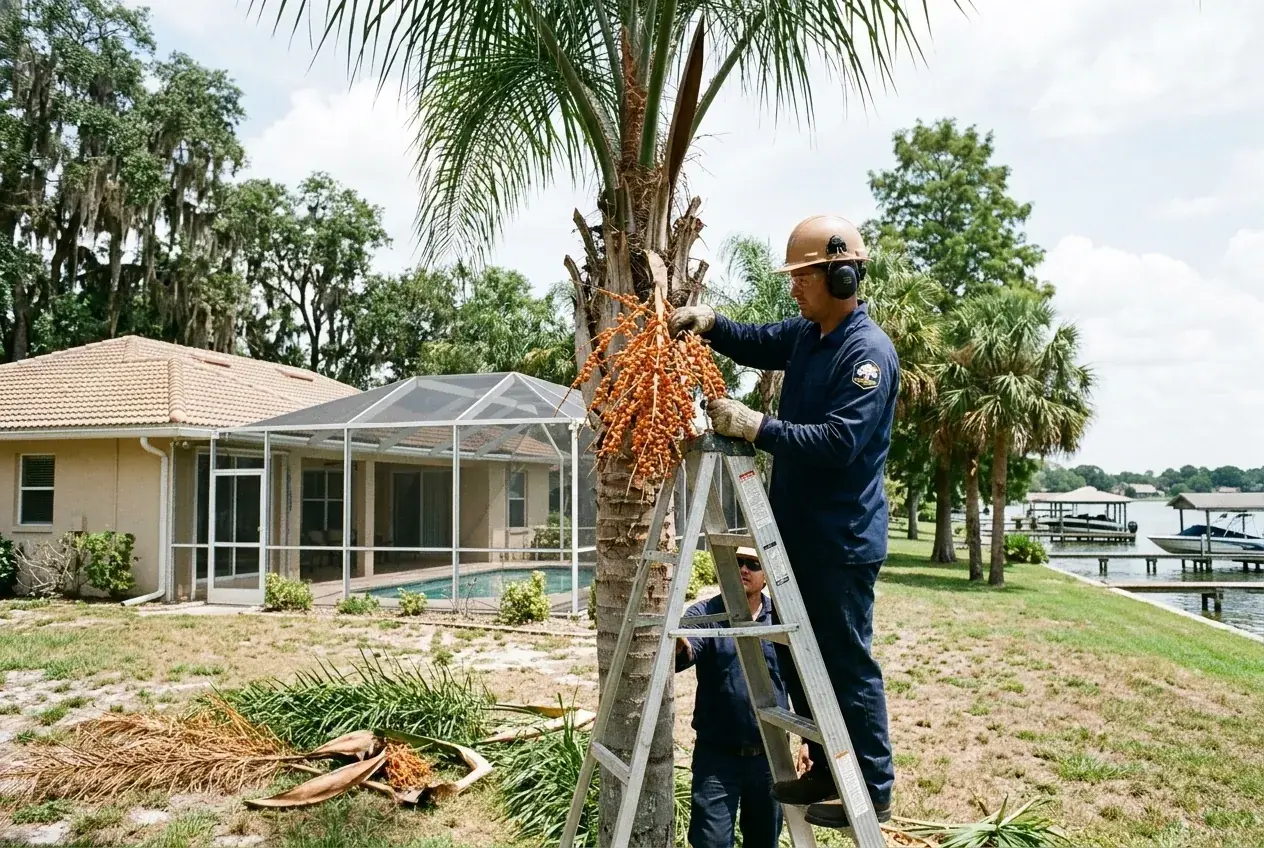
- Cutting flower and seed stalks, and fruit clusters on queen and date palms
- Clearing old frond boots on request where they come away cleanly
- Disinfecting saws between Canary Island date and queen palms to avoid spreading disease
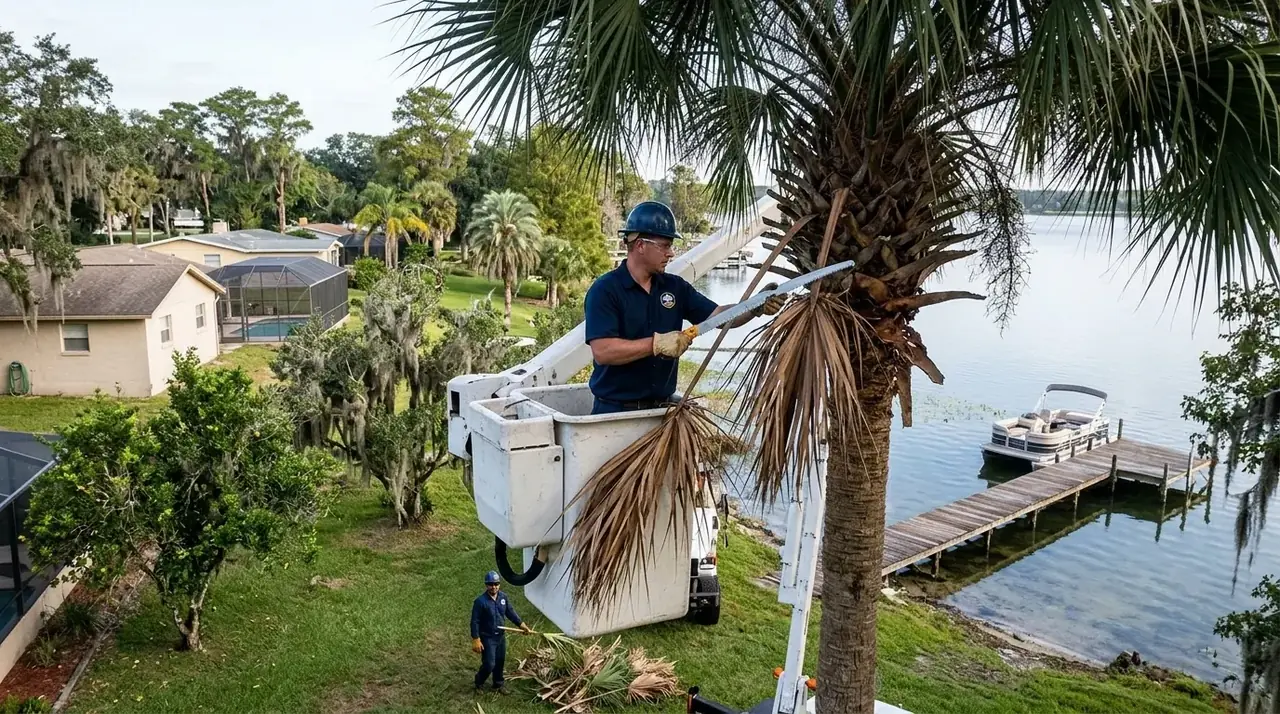
- Bucket or ladder work on healthy palms, with no climbing spikes
- Cleanup and haul-off of every frond and seed pod
Palm Trimming Prices in Winter Haven, FL
Height and species drive the price. A 12-foot sabal by the driveway is quick. A 50-foot Washingtonia with a dense skirt of dead fronds over a pool cage takes a bucket truck and a lot of careful cutting. Most homes have a mix, and we price each palm so you can see where the money goes.
| Job | Typical range | What moves the price |
|---|---|---|
| Short sabal, pygmy date or queen under 20 ft | $85 – $135 | Number of dead fronds, seed stalks |
| Mid-height sabal or queen palm, 20–35 ft | $125 – $200 | Bucket access, what sits under the crown |
| Tall Washingtonia palm, 35 ft+ | $175 – $285 | Height, heavy dead-frond skirt, lift setup |
| Canary Island date palm | $200 – $285 | Thorny fronds, heavy fruit clusters, boot cleanup |
| Lakefront palms by docks or seawalls | add 10 – 30% | Lift placement, keeping fronds out of the water |
Palms that have gone several years without a trim cost a little more the first time, because there are more dead fronds and old flower stalks to clear. After that, a yearly visit keeps the price near the low end of the range.
Palm Trimming for Sabal, Queen, Washingtonia and Date Palms
The sabal, or cabbage palm, is Florida's state tree and the most common palm on local lake lots. It is tough, takes wind well, and needs very little trimming beyond dead fronds and the long flower stalks that show up in summer. Queen palms grow fast and drop heavy clusters of orange fruit that stain pool decks and draw rats; most people here ask for the stalks to be cut before fruit ripens. Queens are also prone to nutrient deficiencies in our sandy soil, which shows up as frizzled new fronds.
Washingtonia palms get very tall and hold onto a skirt of dead fronds that can become a fire risk and a rodent home. Canary Island date palms are big, slow and armored with long spines, so they take careful, slow work. Both date palms and queen palms can carry Fusarium wilt, which spreads on pruning tools. That is why our crew disinfects saws between palms of those types.
Ganoderma and Lethal Bronzing: What to Watch For
Ganoderma butt rot is a fungus that decays the lower trunk of palms. UF/IFAS notes there is no chemical or cultural cure, and the first sign is often a hard, shelf-like conk on the lower trunk. Once that appears, the palm should come down, the stump should be removed or ground, and another palm should not be planted in the same spot without precautions. We can handle the stump grinding the same day.
Lethal bronzing is a newer bacterial disease spread by a small planthopper, and UF/IFAS has documented it in a growing number of Florida counties. It affects sabals, queens and date palms, among others. The early sign is the oldest fronds turning a reddish bronze, followed by the spear leaf dying. We do not diagnose it by eye; if we see the pattern, we will suggest sending a sample to a UF/IFAS lab before deciding on removal.
If a palm is past saving, our crew handles the removal as well. Taking down a palm is usually simpler than felling an oak of the same height because there are no big limbs, but tall palms beside a house still come down in sections. For dead oaks and other hardwoods elsewhere on the lot, see our tree removal service.
Palms Near Roofs, Pool Cages and Power Lines
Tall palms beside the house drop heavy fronds and seed stalks onto shingles and screen roofs, and a dead frond falling from a 40-foot Washingtonia can tear a cage panel. We trim these on a regular cycle and lower big fronds by hand instead of letting them fall. When fronds have grown into the service drop running from the pole to the house, we call the utility before cutting.
Old palms planted close to the house deserve a word, too. Their trunks do not widen much, but their root zones can crowd foundations and pool decks, and a tall palm leaning over a roof is a real hazard in a storm. We will tell you honestly if one has outgrown its spot.
Palm Trimming in Winter Haven: When to Leave Fronds Alone
If every frond is green, the palm does not need trimming. Yellowing on the lowest fronds usually means a potassium shortage, common in Polk County sand, and cutting those fronds off makes it worse because the palm pulls potassium out of them. In that case a palm fertilizer and patience do more good than a saw. We will also tell you if a palm has already been over-trimmed for years; skipping a cycle and letting the crown fill back out is often the best thing for it.
Fresh transplants are another case. A newly planted sabal often arrives with its fronds tied up or cut back hard, and it needs every frond it can grow while new roots form. Leave it alone for at least a year.
Scheduling and Timeline
Palm jobs are fast. Most yards are finished in a few hours, and we can often book within a week. Late spring and early summer are good times for a yearly trim, after flower stalks form but before the heaviest fruit drop. Palms near docks get worked from shore or the dock where possible, with fronds lowered on a rope instead of dropped toward the water; our lakefront tree service page explains how we handle shoreline access.
Palm Tree Trimming on the Chain of Lakes and Nearby Streets
We trim palms on lake lots around the south Chain of Lakes, yards near Lake Conine and Lake Fannie in the north chain, and homes throughout Inwood and Wahneta. If your palms grow along the water, our guide to trees and shorelines on the Chain of Lakes is worth a read. Ready to get on the schedule? Ask for a palm trimming estimate.
Questions
Winter Haven Palm Tree Trimming: Common Questions
Most palms here need trimming once a year. Sabals and Washingtonias can sometimes go longer, while queen palms with heavy fruit may need attention twice a year if the seed clusters bother you. The goal is to remove fronds once they are fully brown, not to keep the palm looking freshly cut. Trimming more often than that rarely helps the palm.
Most palms in the Winter Haven area run $85 to $285 each. Short sabals and queens are at the low end, while tall Washingtonias and spiny Canary Island date palms are at the top. Lakefront access or palms tangled over pool cages can add to the price. We give a per-palm price in writing so you can choose which ones to do.
Generally, yes. Green and yellowing fronds are still feeding the palm, and the palm moves nutrients like potassium out of old fronds before they die. Cutting them early can lead to deficiencies, slower growth and a thinner crown. The exception is a green frond that is broken, rubbing a roof or hanging over a walkway, which we may remove for safety.
A hurricane cut strips a palm down to a few upright fronds, supposedly to make it more wind-resistant. UF/IFAS says the practice is not rooted in science, and over-pruned palms can actually be weaker. A healthy palm with a full crown handles wind well, which is one reason sabals are so common along the lakes. We do not recommend it.
Spikes punch holes in the trunk, and a palm cannot heal those wounds the way an oak can. The holes stay open for life and can let in decay and disease. We use bucket trucks, ladders and other access methods on healthy palms. Spikes are only used on palms that are being removed, where trunk damage no longer matters.
Frizzled, curled new growth on queen palms is a classic sign of manganese deficiency, which is common in sandy, alkaline or poorly fertilized soils. A palm fertilizer with manganese usually helps, though the damaged fronds will not recover; new ones should come in normal. If the spear leaf is collapsing or rotting, that is a different problem and worth a closer look.
The telltale sign is a conk, a hard, shelf-shaped fungus growing on the lower few feet of the trunk, often whitish when young and brown with age. By the time conks appear, the inside of the trunk is usually badly decayed. UF/IFAS advises removing the palm and as much of the stump as possible, and not planting another palm in the same spot without precautions.
Yes, and timing matters. Cutting the flower stalks when they first appear, or the seed clusters while they are still green, stops the mess on pool decks and patios. Queen palms are the main offender, though date palms and Washingtonias produce fruit too. We can schedule your trim for when the stalks show up so one visit handles most of the season.
That is mostly a matter of looks. Boots are the stubs left after fronds are cut, and on sabals they eventually fall off on their own. Some people like the smooth trunk, others like the crosshatched look. If you want them gone, we remove the ones that come away cleanly without cutting into the trunk, which can cause damage.
Once a palm shows symptoms and tests positive, UF/IFAS recommends removing it promptly, since it will not recover and can serve as a source for spread. Nearby healthy palms are sometimes treated preventively by a licensed applicator. We do not diagnose the disease by eye, so if we see the pattern, we will suggest testing through a UF/IFAS lab first.
Related
Other Winter Haven Tree Services
Palms looking shaggy?
Brown fronds and seed stalks off, healthy green left alone. Priced by the palm.
Mon–Sat 7:00am–7:00pm (24/7 emergency line for storm work) · Licensed & insured