
Winter Haven · Polk County, FL
Tree Cabling and Bracing for Winter Haven Oaks
Steel or synthetic cables and through-bolt rods that support weak forks and heavy limbs, so a good oak can stay in the yard. We only recommend it when the wood is sound enough to hold.
Tree Cabling in Winter Haven for Trees Worth Keeping
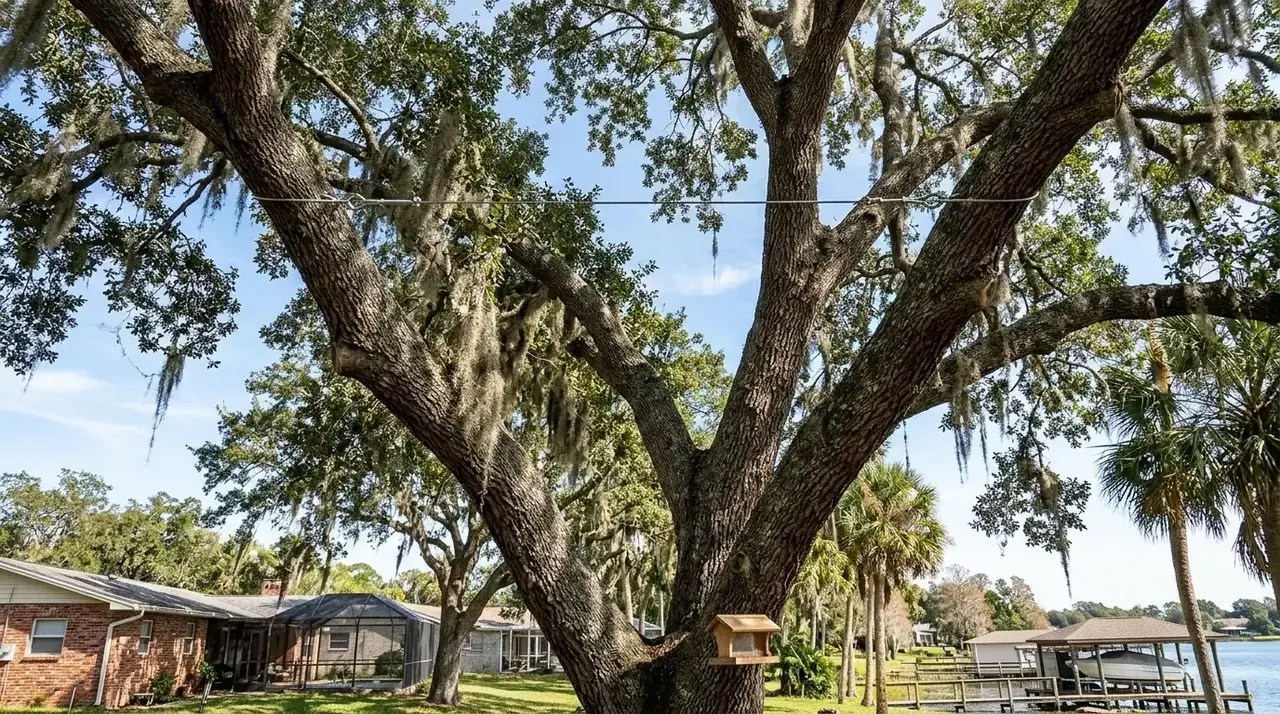
Some trees have a structural flaw but plenty of good years left. The classic example is a big oak with two trunks growing up from the same point in a tight V, with bark pinched into the joint where wood should be. That kind of union, called included bark, can split under wind or the weight of a wet summer canopy. A support cable installed high between the two leaders limits how far they can pull apart, and a brace rod through the union can hold a fork that is already starting to separate.
Cabling is not a cure-all. It reduces the odds of a failure, it does not erase them, and it only works when the wood around the hardware is solid. That is why every cabling job starts with a look at the trunk, the union and the root flare. If the tree is too far gone, we would rather tell you and talk about safe removal than sell hardware that cannot do its job.
Cabling also buys time. Some homeowners use it to keep an important shade tree going for a few more years while a replacement planted nearby grows large enough to take over.
What a Cabling or Bracing Job Includes
- An inspection of the union, the leaders and the base for decay or cracks
- Pruning to reduce end-weight on the limbs being supported
- Steel cable or synthetic dynamic cable installed about two-thirds of the way up from the fork
- Threaded brace rods through split-prone or cracked unions where needed
- Hardware sized to the limbs, installed to ANSI A300 support-system standards
- A follow-up inspection plan so the system is checked over time
Cabling and Bracing Cost in Winter Haven, FL
Most single-tree support jobs here cost between $350 and $1,200. A single synthetic cable in a medium oak is at the low end. A mature live oak with several leaders that need cables plus a brace rod through a cracked union is at the top. Because pruning to lighten the supported limbs is usually part of the job, we price the two together so the number is complete.
| Job | Typical range | What moves the price |
|---|---|---|
| Single synthetic cable, medium tree | $350 – $550 | Height of the install point, limb size |
| Single steel cable, large oak | $450 – $750 | Hardware size, climbing time |
| Multiple cables in one crown | $650 – $1,200 | Number of leaders, layout of the system |
| Through-bolt brace rod at a cracked union | $350 – $700 | Trunk diameter, number of rods |
| Weight-reduction pruning with cabling | Quoted with the job | Canopy size, how much end-weight to remove |
Steel Versus Synthetic Cable
Steel systems use anchors threaded or bolted into each leader, with cable stretched between them. They are strong and long-lasting, and they suit large, heavy limbs. Synthetic systems use a braided line that wraps around the limbs, often with no drilling, and they allow a little stretch so the tree can still move in wind. They work well on medium trees and on limbs where drilling is a concern. We choose based on the tree, the size of the limbs and how much movement the fork needs to control.
Cabling Winter Haven Live Oaks and Laurel Oaks
Live oaks are the best candidates. Their wood is dense, they live a long time, and a well-placed cable can keep a heavy leader in place for decades. Many of the broad old live oaks shading streets near downtown and the lakes have the wide, spreading limbs that benefit from support. Laurel oaks are a tougher call. Their wood is weaker, they tend to decay from the inside as they age, and a cable is only worth installing if the tree is still young and sound enough to justify it.
Southern magnolias, sycamores and some pines can also develop co-dominant leaders. On magnolias we sometimes cable a fork over a driveway; on pines, a split usually means removal, since a pine cannot compartmentalize damage well enough to make hardware worthwhile. Old citrus is rarely cabled; it is usually better to replace it. In every case, structural pruning to lighten the load does part of the work before any hardware goes in.
Young trees are a different conversation. A ten-year-old oak with two leaders competing for the top usually does not need hardware at all; one well-timed pruning cut that shortens the weaker leader lets the stronger one take over. Catching that early is far cheaper than cabling the same tree twenty years later, and it is one reason we recommend structural pruning while trees are small.
Hurricane Season and Supported Trees
A cable will not keep a whole tree standing if its roots let go in saturated sand, and it will not stop a rotten limb from breaking. What it does is reduce the chance that a weak fork splits in a strong gust, which is a common way big oaks fail when storms like Ian and Milton cross Polk County. Pair support with good pruning and a healthy root zone, and you give a valuable tree the best odds.
Checking Hardware After a Storm
After any named storm, walk out and look up at the cable. If it hangs slack, has pulled loose from an anchor, or the leaders look farther apart than before, call us. Cracks at the union, fresh bark tearing around an anchor and fine sawdust at the base are other warning signs. Most checks take a few minutes, and loose hardware is far cheaper to fix than a split tree.
When Tree Cabling in Winter Haven Is the Wrong Choice
Skip cabling if the union already has a deep crack running into the trunk, if there is significant decay at the base, if mushrooms or conks are growing from the roots, or if the tree leans hard over the house. Hardware anchors into wood; if the wood is soft, the anchors will pull out. We also advise against cabling a tree you plan to remove within a couple of years anyway, since that money would be better spent on the removal. When you are unsure, a tree risk assessment can help sort a fixable flaw from a tree near the end.
A cable is also the wrong tool for a tree that simply leans. Lean comes from the trunk and roots, not the fork, and guying a big tree to the ground is a specialized job that rarely makes sense in a residential yard. Most leaning trees here are either fine as they are or need to come down.
How Long Installation Takes
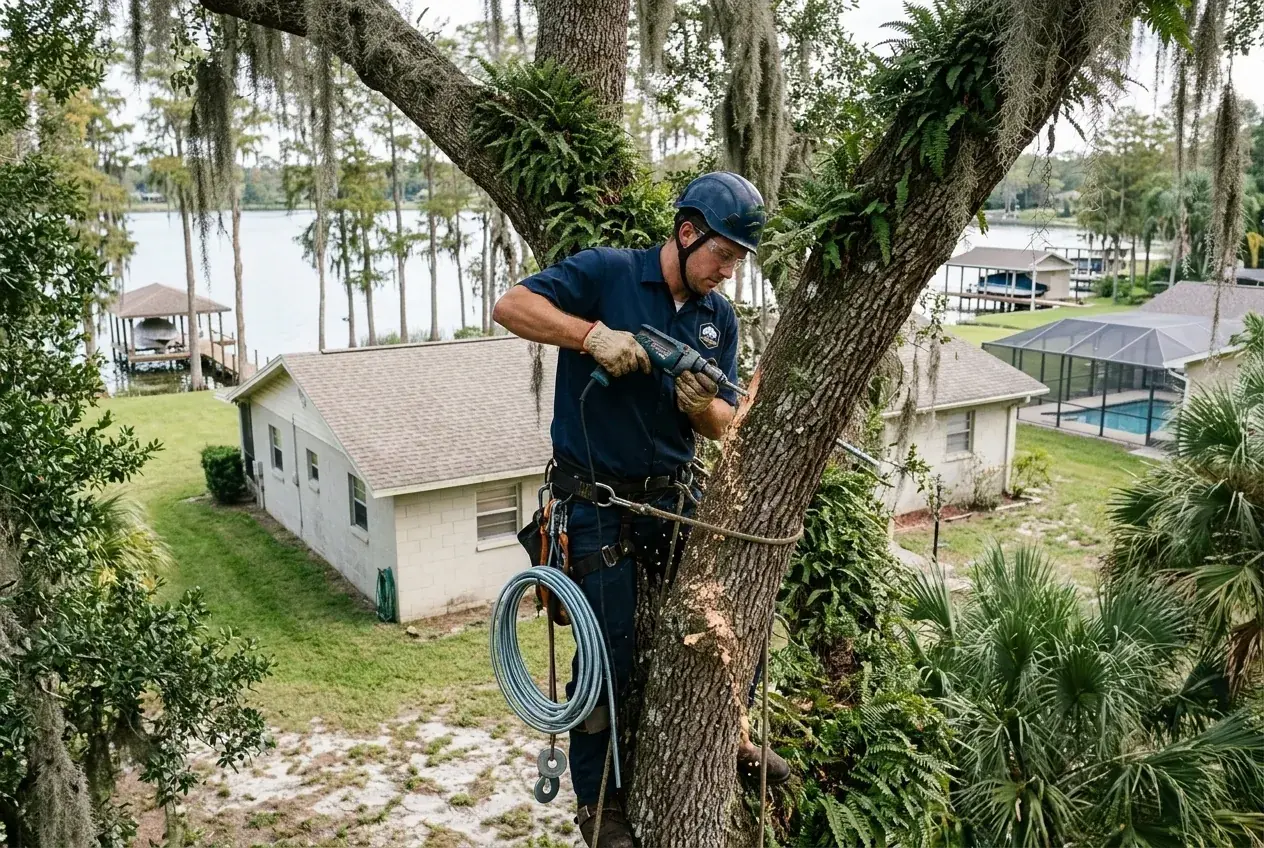
Most cabling jobs take a few hours to half a day, including the pruning that goes with them. We usually schedule within one to two weeks of approval. The climber installs the hardware at height while the ground crew handles the pruned limbs and cleanup. You will get a simple record of what was installed and where, which is handy for future inspections and for anyone who buys the house after you. Most installs need no heavy equipment, so lawns, beds and irrigation stay untouched.
If a cabled tree changes hands, or you have inherited one from a previous owner, we are glad to inspect hardware someone else installed. We note its condition, adjust or replace what needs it, and give you a written record going forward.
Tree Bracing Near Lake Howard, Cypress Gardens and Jan Phyl Village
We install support systems on oaks across Winter Haven, including older trees near Lake Howard and downtown, large shade trees in Cypress Gardens, yards in Jan Phyl Village and lake lots on the south chain. Thinking about which trees to plant for the long haul? Our shade tree guide favors strong-wooded species. For a cabling price, request a free estimate.
Questions
Winter Haven Tree Cabling & Bracing: Common Questions
Tree cabling is the installation of a steel or synthetic cable high in the crown between two or more leaders or heavy limbs. The cable limits how far they can move apart in wind, which lowers the strain on a weak fork. It is used on trees with structural defects that are otherwise healthy, to reduce the chance of a split and extend the time the tree can stay.
Cabling uses a flexible cable high in the canopy to limit movement between limbs. Bracing uses a rigid threaded steel rod installed through a union or a crack, lower in the tree, to hold wood together. Cables handle sway; rods handle separation at the joint. Many jobs use both: a brace rod at a cracked fork and a cable above it to share the load.
Most single-tree cabling and bracing jobs in Winter Haven run $350 to $1,200. A single synthetic cable in a medium oak is at the low end, while a large live oak needing several cables and a brace rod is at the high end. Weight-reduction pruning is usually part of the job, and we include it in the written price.
It improves the odds, but nothing makes a tree hurricane-proof. A cable reduces the chance that a weak fork splits under strong wind. It will not hold up a tree whose roots fail in soaked soil, and it will not prevent a decayed limb from breaking. Combined with good pruning and regular inspections, it is a reasonable way to protect a valuable tree.
Installing hardware does create small wounds where anchors go in, but a healthy tree seals around them over time. Synthetic systems that wrap around limbs without drilling are another option in some cases. Installed correctly and inspected regularly, a support system does far less harm than a split trunk would. The bigger risk is letting the tree grow around a loose or worn cable that no one checks.
Steel systems can last many years, while synthetic cables are typically rated for a shorter service life and need replacement on a schedule. Either way, the tree keeps growing and the hardware needs checking. We suggest an inspection every year and after any named storm. Adjustments or replacements are usually quick and inexpensive compared with the original job.
Sometimes. If a fork has started to separate but the wood is sound and the crack is not too deep, a through-bolt brace rod plus a cable above it can hold it. If the split runs deep into the main trunk, the wood is decayed, or the tree is a species with weak wood like a pine, removal is usually safer. We judge each case on site.
Healthy live oaks with co-dominant leaders are the best candidates, because their wood is dense and they live a long time. Southern magnolias and some other hardwoods can also be good candidates. Older laurel oaks and water oaks are borderline because of their weaker wood and tendency to rot. Pines and old citrus are rarely worth cabling.
There is usually no requirement to report it, but keeping our record of what was installed and when is a good idea. If a supported tree ever causes damage, showing that the defect was addressed and inspected can help. If you sell the house, pass the record along to the buyer so they know to keep up the inspections.
Yes, and it usually should be. Reducing end-weight on the limbs being supported takes strain off both the fork and the hardware. We prune first, then install the cable or rod in the same visit, and clean up everything at the end. Combining the work also saves you a second setup charge and keeps scheduling simple.
Related
Other Winter Haven Tree Services
Worth keeping that oak?
We will tell you honestly whether cabling makes sense or the tree is too far gone.
Mon–Sat 7:00am–7:00pm (24/7 emergency line for storm work) · Licensed & insured