
Winter Haven is a demanding place to grow a big tree. Summers are long and hot, the soil drains fast, afternoon storms are frequent and hurricanes come through often enough that wind resistance is not optional. The good news is that UF/IFAS has done the homework, and several native trees fit our yards very well.
Winter Haven Shade Trees and the USDA Hardiness Zone
On the 2023 USDA Plant Hardiness Zone Map, Winter Haven's ZIP codes, 33880, 33881 and 33884, fall in Zone 10a, where the average coldest winter night runs 30 to 35 degrees. The previous 2012 map put the area in 9b. Either way, the trees below handle our winters, and the occasional hard freeze is more of a concern for tender tropicals than for native shade trees.
Best Shade Trees for Winter Haven, Ranked for Wind
UF/IFAS researchers studied urban trees after ten hurricanes and grouped species by how well they stood up to wind. For a shade tree near a house, we lean hard on the top of that list. Here are the trees we recommend most, with their UF/IFAS Southeastern Coastal Plain wind rating.
| Shade tree | Why it works in Winter Haven |
|---|---|
| Live oak | Highest wind resistance; long-lived; needs plenty of room to spread |
| Sand live oak | Highest wind resistance; smaller and suited to dry, sandy ridge soils |
| Southern magnolia | Highest wind resistance; evergreen shade and big white flowers |
| Bald cypress | Highest wind resistance; narrow canopy; handles wet or dry sites |
| Sweetbay magnolia | Medium-high wind resistance; good for damp, low spots |
| Sweetgum | Medium-high wind resistance; fall color, but drops spiky seed balls |
| Red maple | Medium-low wind resistance; pretty, but plant away from the house |
For smaller spaces, crape myrtle and podocarpus also sit in UF/IFAS's highest wind group. Neither throws heavy shade, but both are useful where a big oak would outgrow the lot.
Trees we suggest skipping near the house
Laurel oak and water oak grow fast and look great when young, which is why so many were planted in older Winter Haven subdivisions. Both land in the lowest wind group in the UF/IFAS research, and laurel oak typically starts to decay around age 40. Camphor is invasive and not recommended by UF/IFAS, and Chinese tallow is prohibited in Florida. Sand pine is also in the lowest wind group. If you already have these trees, there is no need to panic, but don't plant new ones within reach of your roof.
Right Tree, Right Place in Winter Haven Yards
Florida-Friendly Landscaping, the UF/IFAS program, starts with one principle: right plant, right place. For trees, that means sizing the tree to the space it will have at maturity, not the space it fills at the nursery. A live oak can eventually spread wider than most Winter Haven lots are deep.
Shade trees near power lines
UF/IFAS advises planting large-maturing trees at least 40 feet from overhead wires. A UF/IFAS Extension publication from Duval County suggests that trees within 20 feet of a line be small species that stay under about 25 feet, such as redbud, crape myrtle or chaste tree. Trees that grow into lines eventually get cut back hard by utility crews, which leaves them lopsided and weak. Before digging any planting hole, call 811 so underground lines can be marked.
Shade trees near septic systems
Many homes in unincorporated areas around Winter Haven are on septic. UF/IFAS advises estimating a tree's mature canopy width and planting at least that far from the tank and drain field, because roots can spread two to three times the canopy width. Our post on tree roots, septic tanks and sewer lines in Polk County goes deeper into spacing and species.
Shade trees near the house and pool
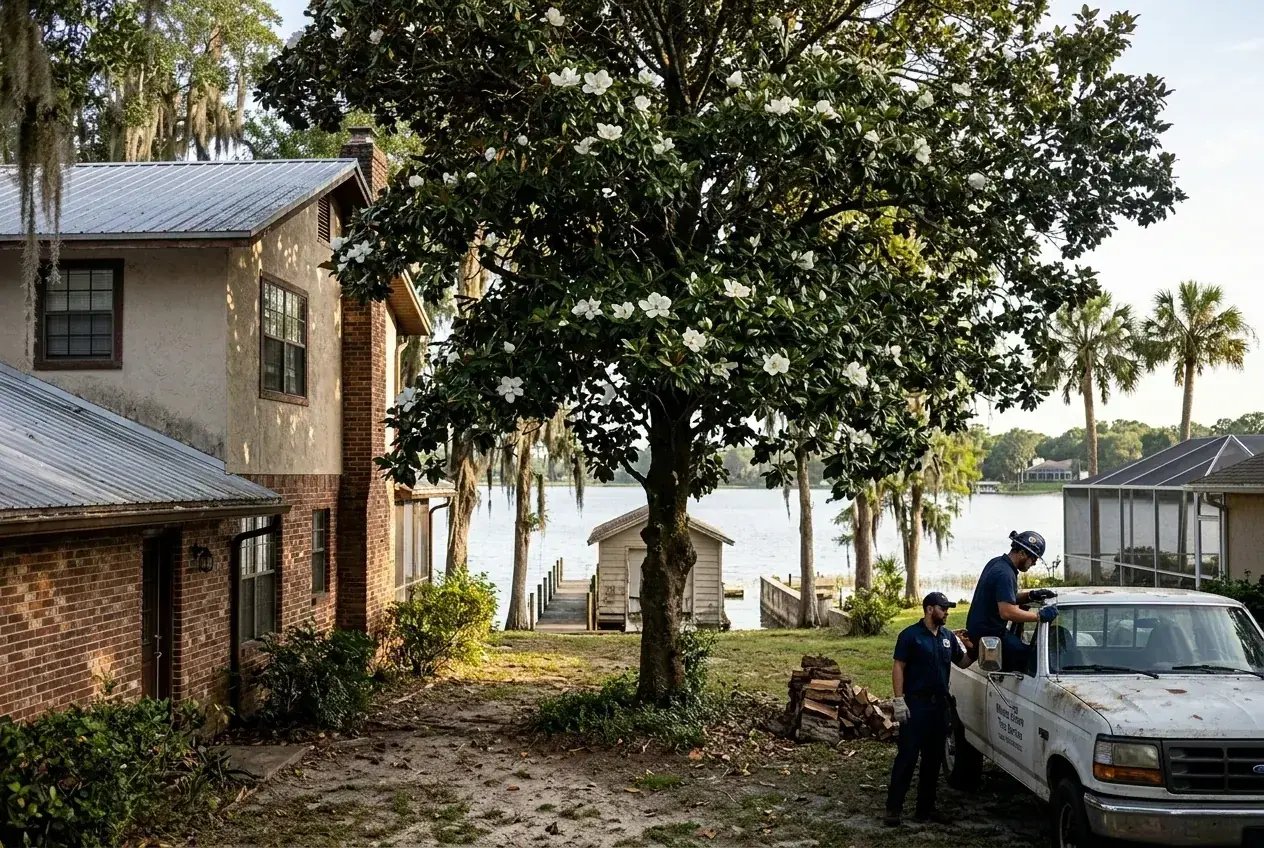
Give large trees at least 20 feet from the foundation, and more for live oaks. Pool cages, gutters and screened lanais collect leaves, so evergreen trees with small leaves, like live oak, still mean regular cleanup. Southern magnolia drops large, tough leaves all year. Plan for that before planting one next to the pool.
Lakefront Shade Trees on the Winter Haven Chain of Lakes
Lakefront lots need trees that tolerate wet feet and the wind that crosses open water. Bald cypress is the natural pick at the water's edge. Sweetbay magnolia and red maple handle damp soil a little farther up the bank, and live oak does well on higher ground behind them. Avoid planting anything that will lean out over a dock as it reaches for light. Our article on trees and shorelines on the Chain of Lakes explains the shoreline rules that apply before you clear room for a new tree. Homes on the North Chain of Lakes and around Lake Silver downtown are good candidates for this layered approach.
Small Shade Trees for Tight Winter Haven Lots
Not every yard has room for a live oak. Many lots in older parts of town are narrow, with a house, a driveway and a pool cage taking most of the space. On those lots a smaller tree that stays in scale is the better long-term buy. A few that sit in UF/IFAS's highest wind-resistance group for our region:
- Crape myrtle, a non-native that flowers all summer and stays small enough for side yards. Skip the hard annual topping often seen on these trees; it weakens the branch structure.
- Yaupon holly and dahoon holly, native hollies with berries birds love. Dahoon tolerates wetter soil.
- American holly, a slow-growing native with a tidy, upright shape.
- Podocarpus, a dense evergreen often used as a screen or a small specimen tree.
Sabal palm, Florida's state tree, is also in the top wind group and handles our sand well. It gives little shade, but a cluster of sabals near a patio can soften the afternoon sun without the leaf litter of a broadleaf tree.
Buying a Good Shade Tree in Polk County
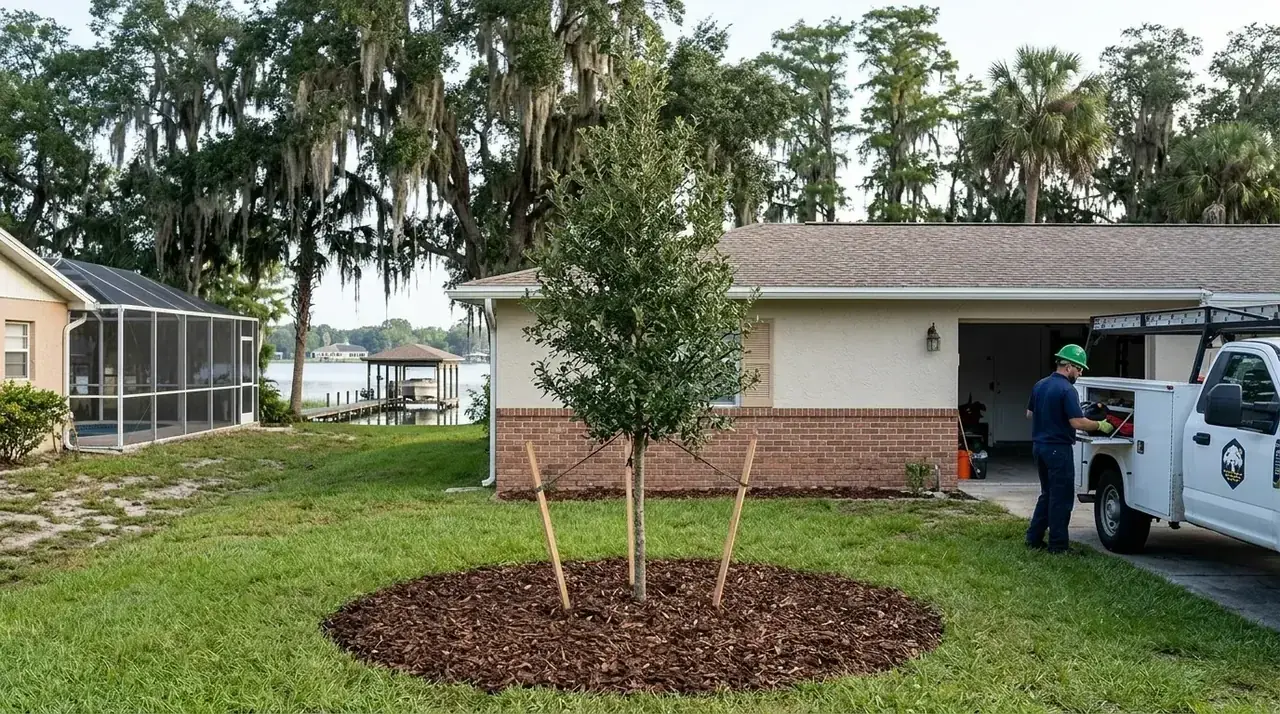
The tree you bring home matters as much as the species. UF/IFAS recommends planting high-quality trees with a central leader and good structure, and that is easy to check at the nursery. Look for one dominant trunk running up the middle, branches spaced along it rather than bunched at one height, and no roots circling tightly around the top of the root ball. Pass on trees with two trunks of equal size competing for the top. Those codominant stems are the ones we see split apart in storms twenty years later.
Bigger is not always better. A smaller container tree usually establishes faster in sandy soil than a large one that lost most of its roots when it was dug, and it often catches up within a few years. If you want instant size, budget for careful watering through at least the first full summer.
Planting and Early Care for Winter Haven Shade Trees
A few habits make the difference between a tree that thrives and one that limps along:
- Plant at the right depth, with the top of the root flare visible at the soil line.
- Water frequently for the first growing season, since our sandy soils dry out fast.
- Keep mulch a few inches away from the trunk.
- Start structural pruning early so the tree develops one strong central leader.
Early structural pruning is cheap and pays off for decades. Our tree trimming and pruning crews can shape young trees so they don't develop weak, codominant trunks that split in storms.
Replacing a Removed Tree in Winter Haven
Many people come to this question after losing a tree to a storm or to old age. The space left behind is a chance to choose something better suited to the spot. If an old laurel oak or a declining citrus tree is coming out, we can handle the tree removal and stump grinding so the site is ready for a new tree. Grinding the old stump also gives new roots room to spread.