
Citrus is woven into Winter Haven's history. The city held its first Orange Festival in January 1924, with citrus displays set up around Central Park, and the event ran for 84 years under several names, according to Citrus Industry magazine. Packing houses, canneries and groves surrounded the lakes. John A. Snively, who started in Winter Haven as a fertilizer salesman in 1910, built Snively Groves into one of the largest fruit packing and canning operations in the country by the 1930s. Many of the dooryard trees we see today trace back to that era or to the plantings that followed.
Those trees now face a disease the early growers never dealt with. Citrus greening has changed what a backyard orange tree can be expected to do.
Citrus Greening and Old Citrus Trees in Winter Haven
Citrus greening, also called huanglongbing or HLB, is a bacterial disease spread by the Asian citrus psyllid, a tiny insect that feeds on new citrus growth. The psyllid was first found in Florida in June 1998, and greening was confirmed in the Homestead and Florida City area in August 2005, according to UF/IFAS. It has since spread statewide.
UF/IFAS Extension is blunt about the disease. There is no cure for an infected tree. Pesticides control psyllids but do not cure the tree, and early infections can go months without visible symptoms while still serving as a source for neighbors' trees. Florida's commercial orange crop shows the scale of the problem: USDA's preliminary summary put the 2024-25 all-orange crop at 12.2 million boxes, down 32 percent from the season before.
Signs a citrus tree is declining
- Blotchy, uneven yellowing on leaves that does not match on both sides of the vein.
- Thin canopy with twig dieback at the top and edges.
- Small, lopsided fruit that stays partly green and tastes bitter or sour.
- Heavy fruit drop well before harvest season.
Those symptoms overlap with nutrient deficiencies, which greening itself can cause, so appearance alone is not a firm diagnosis. Your county Extension office can tell you about testing options.
Should You Keep or Remove an Old Citrus Tree in Winter Haven?
There is no single right answer. The table below is how we talk it through with homeowners.
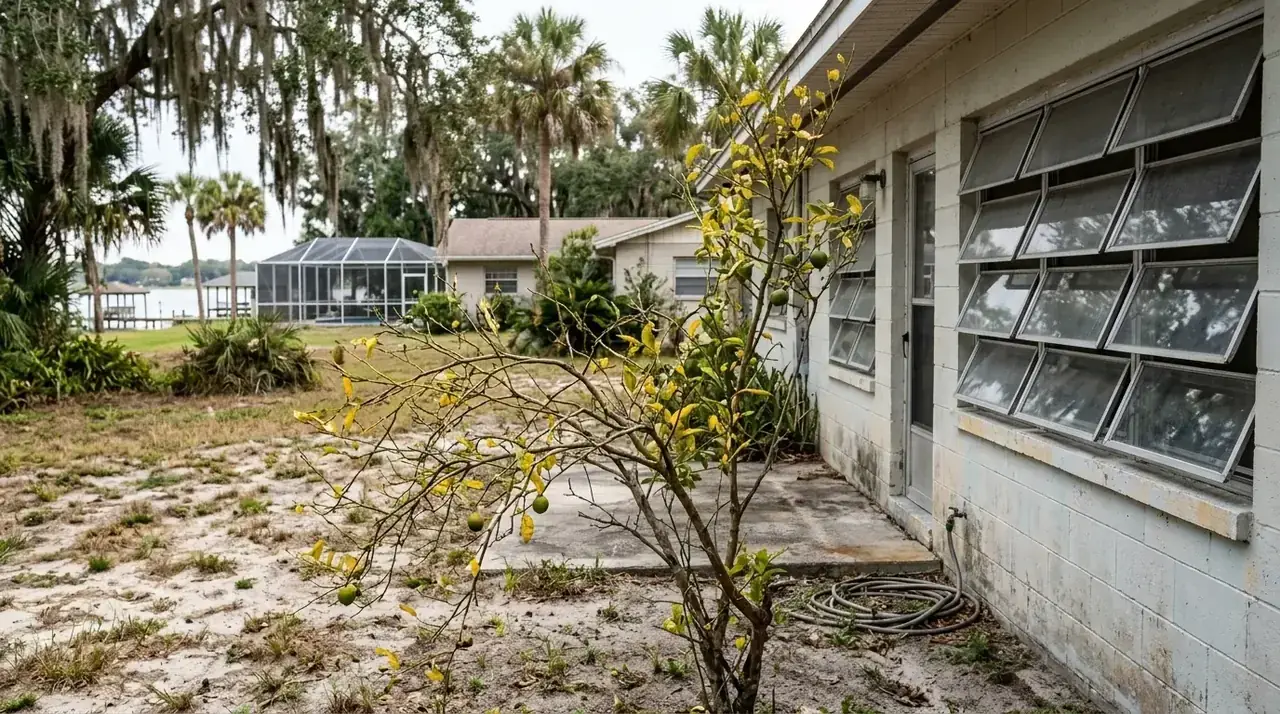
| What you see | What we usually suggest |
|---|---|
| Full canopy, good fruit, no blotchy leaves | Keep it; follow UF/IFAS home citrus care guidance |
| Thinning canopy, fair fruit, tree has sentimental value | Keep and monitor for a season or two |
| Heavy dieback, bitter fruit, sparse leaves | Remove; the tree is unlikely to recover |
| Dead limbs over a roof, fence or pool cage | Remove or prune the dead wood now |
| Tree shades out a spot you want for a new shade tree | Remove and replant with a non-citrus species |
UF/IFAS Extension says tree removal is the only way to stop an infected tree from spreading greening. If you keep a tree, the UF/IFAS publication Citrus Tree Care for the Home Gardener in the HLB Era (PP336) covers fertilizing, watering and psyllid management that can help a tree hold on longer. Healthy-looking trees can still be infected, so keeping one is a calculated choice, not a cure.
Citrus Tree Trimming in Winter Haven for Trees You Keep
If your tree still bears decent fruit and you want to give it a few more years, light pruning helps. The goal is to take out dead and crossing wood, open the center so air moves through, and keep limbs off the roof and the pool cage. Heavy cuts are a poor idea on a stressed tree. Every large wound costs the tree stored energy it may not be able to spare, and the flush of new shoots that follows hard pruning is exactly the tender growth psyllids feed on.
- Remove dead branches back to live wood, cutting just outside the branch collar.
- Thin a few crowded interior limbs instead of shearing the outside of the canopy.
- Pull sprouts that come up from below the graft union near the base, since they are rootstock, not the fruiting variety.
- Clean up fallen fruit and leaves under the tree so the ground stays tidy and pests have less to work with.
Our tree trimming and pruning crews handle this kind of careful work, and pruning is usually priced well under a removal.
Old Citrus Trees and Your Neighbors' Yards
Greening is a neighborhood problem as much as a single-yard problem. The psyllid flies from tree to tree, and an infected tree that looks fine can still feed the bacteria to insects that move next door. If you are on the fence about a declining tree and your neighbors are trying to keep their citrus going, removal is a considerate choice. If several houses on a street are dealing with the same thing, coordinating removals on one day can also lower the cost for everyone, since the crew and equipment only come out once.
What a Citrus Tree Removal Visit Looks Like
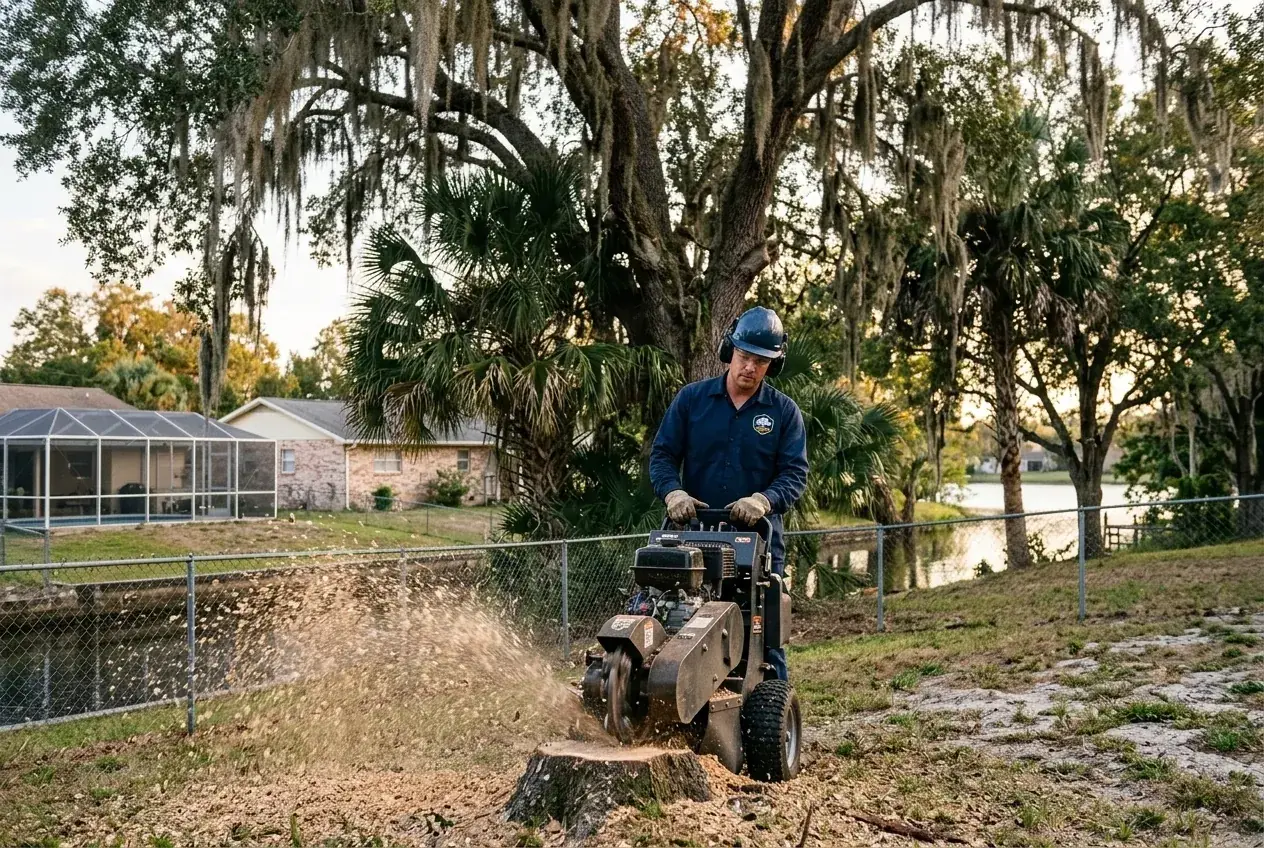
Most backyard citrus jobs move quickly. We protect the lawn and fences, cut the tree down in sections, chip the branches on site and load the trunk wood. Then we grind the stump and the main roots, rake the area level and blow off the patio and driveway. Thorny trees like some lemons and older sour orange rootstock sprouts get handled with heavy gloves and extra care. The whole visit often takes an hour or two for a single tree, longer when several come out together.
Old Citrus Tree Removal and Disposal in Winter Haven
Most backyard citrus trees are small enough to be quick removals. A typical orange or grapefruit falls in our small-tree range, $325 to $850, and the price drops when several trees come out on the same visit. Thorny varieties take a little longer to handle, and old grove trees with wide, low canopies sometimes need more cuts than their height suggests.
UF/IFAS Extension recommends removing all of the tree material, including the stump and roots, because leftover roots and sprouts can keep feeding psyllids. That makes stump grinding worth doing on an infected citrus tree even when you might skip it on another species. We grind out the stump, chase the major roots and rake the area level.
As for disposal, we chip the branches and haul everything off as part of the removal. Please do not hand out cuttings or try to graft from an old tree. UF/IFAS notes that grafting and budding are restricted to certified nurseries working from certified mother trees, and homeowner grafting is illegal in Florida.
Replanting Citrus in Winter Haven With Certified Trees
If you want citrus again, buy from a registered Florida nursery. Since January 1, 2007, Florida's Citrus Nursery Stock Certification Program has required citrus nursery stock to be propagated in approved enclosed structures designed to keep psyllids out. A certified tree starts clean, though it can still become infected later in the yard.
UF/IFAS Extension also points out that a tree from outside the citrus family, Rutaceae, can be planted in the same spot without greening risk. That opens the door to a shade tree, a flowering tree or a fruit tree that greening does not affect. Our list of the best shade trees for Winter Haven yards has options that fit the old citrus spot well.
Old Citrus Trees Around Winter Haven Neighborhoods
We find leftover grove trees all over the area. Older lots in Florence Villa often have a tree or two near the back fence. The Florence Villa Hotel was part of early citrus history too; local growers sold gift fruit to winter visitors staying there. In Jan Phyl Village and other mid-century neighborhoods, citrus was a common backyard planting when the homes were new. Many of those trees are now well past their productive years.
If you have a mix of old citrus and bigger yard trees to deal with, we can handle it in one visit. Our tree removal service includes full cleanup and haul-off, and our trimming crews can clean dead wood out of a citrus tree you have decided to keep.